.svg)
Best sales prospecting tools for SMB outreach (2026)
Most sales prospecting tools are built for enterprise B2B. They index Fortune 500 companies, track funding rounds, and surface LinkedIn contacts — none of which helps a sales team targeting local business owners. This guide covers the best sales prospecting tools for SMB outreach in 2026, with a focus on local business coverage, verified owner contacts, and pricing that doesn't require a procurement team.
Why most sales prospecting tools fail for local SMB outreach
Before diving in, it helps to understand why search results for this topic are so confusing.
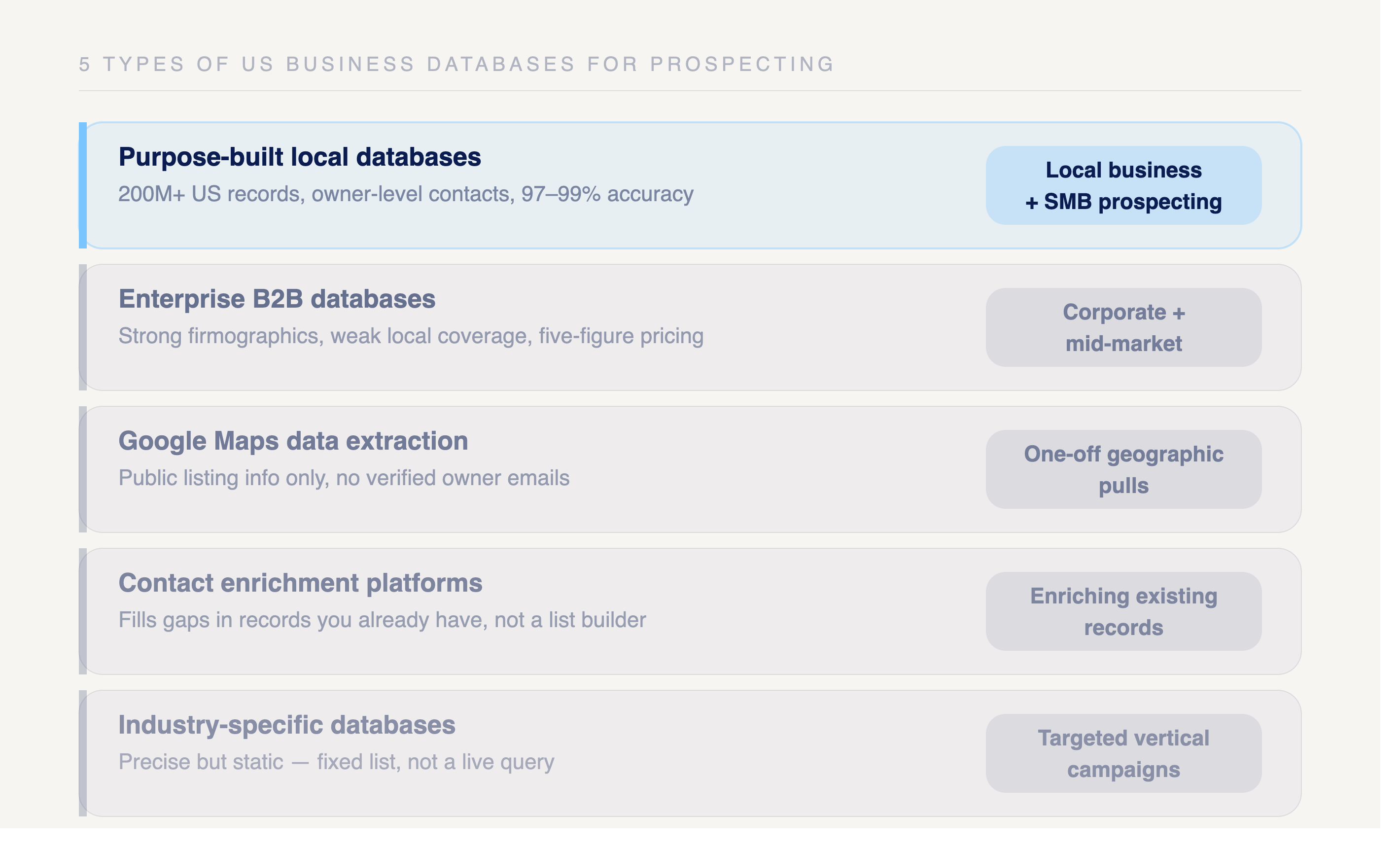
Type 1: Listing directories. These are consumer-facing platforms where businesses list themselves to be found by local customers. They're built for local SEO visibility and are not prospecting tools.
Type 2: Prospecting databases. These are platforms that aggregate, verify, and sell access to business contact data. Sales teams use them to build lead lists, enrich existing records, and find owner-level contacts at local businesses. This is what most B2B buyers actually mean when they search "business listings database."
The rest of this article covers Type 2 only.
What makes a good sales prospecting tool for SMB outreach
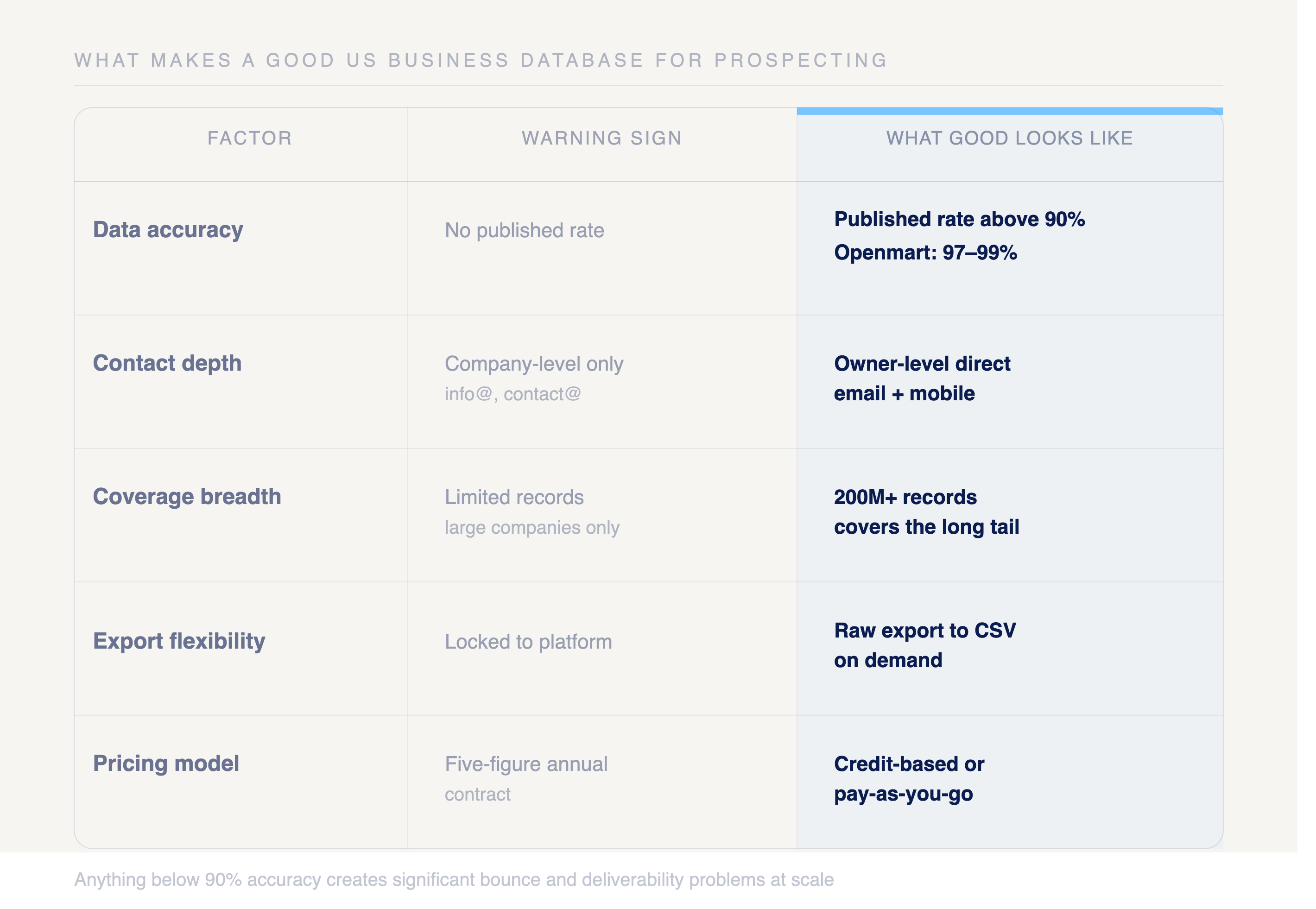
Not all business databases are built the same. Before evaluating any platform, these are the factors that actually matter:
Data accuracy. Stale data is worse than no data: it wastes outreach time and burns sender reputation. Look for platforms that publish an accuracy rate. Anything below 90% will create significant bounce and deliverability problems at scale.
Contact depth: owner-level vs. Company-level. Most databases capture company emails (info@, contact@, or linkedin-sourced corporate contacts). For local business prospecting, that's often useless: you need the owner's direct email or mobile. Owner-level contact depth is the single biggest differentiator between platforms built for SMB prospecting and those built for enterprise sales.
Coverage breadth. How many US businesses are in the database? A platform with limited records covers large companies well. A platform with 50M+ records covers the long tail of local businesses: restaurants, auto shops, medical practices, contractors, that most databases miss entirely.
Export flexibility. Can you export to CSV on demand, or are you locked into a platform workflow? For teams doing outreach in their own tools, raw export matters.
Pricing model. Enterprise databases charge five-figure annual contracts. Most SMB prospectors don't need that. Look for credit-based or pay-as-you-go pricing that scales with actual usage.
The best sales prospecting tools for SMB outreach in 2026
Ranked by SMB data depth, owner-level contact accuracy, pricing transparency, and outreach features. Each tool evaluated against the same criteria for teams selling to local and small businesses.
1. Openmart — best for local business owner contacts
Best for: sales reps and marketers targeting local businesses, restaurants, healthcare practices, auto shops, retail stores, and any SMB category where the owner's direct contact matters.
Openmart is the only sales prospecting tool built specifically for local SMB outreach. It combines a 50M+ verified local business database with owner-level contact data and built-in email sequencing, the full prospecting workflow in one platform. For sales teams targeting restaurants, contractors, salons, or any owner-operated business, Openmart covers the market that Apollo and ZoomInfo miss entirely.
The database covers 50M+ US SMB records with verified owner-level contact data: direct emails, phone numbers, and business details across 300+ categories. Data accuracy runs 97-99%, meaningfully higher than what general databases deliver for local business records. Most databases source contacts from LinkedIn or company websites, which captures corporate employees, not local business owners. A restaurant owner, a dentist, or an auto repair shop owner is rarely on LinkedIn with a verified work email. Openmart is built around exactly this gap.
Pros: 50M+ SMB records across 300+ categories, 97-99% verified owner contact accuracy, direct emails and mobile numbers for owners, daily database refresh, built-in email sequencing
Limitations: lighter coverage for large enterprise and Fortune 500 contacts than tools built for that segment
Pricing: free tier with 200 credits/month; paid plans from $149/month
Explore Openmart's local business database →
2. Apollo.io — best for SaaS and mid-market outbound
Best for: sales teams selling to SaaS buyers or mid-market companies that need a full outbound stack in one tool.
Apollo.io is a unified outbound platform with 230M+ contacts and strong coverage for SaaS and mid-market accounts. It bundles sequencing, a dialer, enrichment, and CRM sync into one subscription, which makes it a popular default for teams that haven't specialized their stack yet.
The tradeoff shows up once the target list shifts toward local businesses. Apollo's contact base leans on LinkedIn and company-site sourcing, the same structural gap that misses SMB owners who don't maintain a LinkedIn profile. Coverage of brick-and-mortar businesses (restaurants, contractors, local retail) is thinner than its enterprise and SaaS coverage.
Pros: full outbound stack in one platform, 230M+ contacts, free tier available, broad SaaS and mid-market coverage
Limitations: local business and SMB owner coverage is thinner than enterprise/SaaS coverage; owner-level accuracy drops for brick-and-mortar businesses
Pricing: free tier (60 credits/month); paid plans from $49/user/month
3. ZoomInfo — best for enterprise and Fortune 500 prospecting
Best for: enterprise sales teams prospecting Fortune 500 and large mid-market accounts with dedicated procurement budget.
ZoomInfo is the largest North American B2B database, with 320M+ profiles and deep firmographic and technographic filters. For enterprise sales teams targeting large companies, the depth of org-chart and intent data is hard to match.
That depth is built for a different buyer. ZoomInfo's contact sourcing skews toward company websites and LinkedIn, which is where enterprise employees show up and where local business owners typically don't. Contracts also start at a scale that doesn't fit most SMB-focused teams.
Pros: 320M+ profiles, direct dials for enterprise decision-makers, advanced intent and technographic filters
Limitations: built for large-company org charts, not owner-operated local businesses; annual contracts starting around $15,000
Pricing: annual contracts, typically starting near $15,000/year
4. Cognism — best for EMEA phone-verified outreach
Best for: outbound teams running phone-heavy prospecting campaigns across the UK, France, and Germany.
Cognism's differentiator is human-verified mobile numbers (its "Diamond Data" set) and a GDPR-first compliance posture, which makes it a strong fit for EMEA-focused sales teams that lean on calling. Coverage and compliance tooling for European markets are genuine strengths.
For SMB outreach in the US, Cognism doesn't publish SMB-specific coverage stats or owner-level filters, and its data strength is concentrated in EMEA markets rather than US local businesses. Pricing isn't published; it requires a sales conversation.
Pros: human-verified mobile numbers, strong UK/France/Germany coverage, built-in compliance tooling for GDPR and do-not-call lists
Limitations: no published SMB owner-level coverage data; strongest in EMEA, not US local business; pricing requires a sales call
Pricing: not publicly listed; contact sales for a quote
5. Clay — best for custom enrichment workflows
Best for: technical or ops-heavy teams that want to build custom enrichment and outreach workflows by combining multiple data sources.
Clay is a workflow tool, not a standalone database. It lets teams pull data from dozens of third-party sources and providers, then chain enrichment steps together with custom logic. That flexibility is the appeal, and it's also the tradeoff: Clay's value depends entirely on which data sources get plugged in, and it takes setup time to configure a workflow before any prospecting starts.
For teams targeting local SMBs, Clay doesn't have a native SMB owner-contact database of its own. It's better thought of as an assembly layer that sits on top of other data providers rather than a source of owner-level local business contacts.
Pros: highly customizable workflows, connects to many third-party data sources, useful for teams with existing enrichment pipelines
Limitations: no native SMB owner-contact database; requires setup time and technical comfort before it produces a usable list
Pricing: credit-based; contact for current rates
6. Origami — best for general B2B contact search
Best for: teams that need a straightforward contact search tool for general B2B prospecting.
Origami operates in the same general B2B contact space as the tools above. As with the other general-purpose platforms on this list, teams selling to local business owners should check owner-level contact depth and SMB coverage specifically, rather than assuming enterprise-oriented contact coverage transfers to brick-and-mortar businesses.
Pros: general B2B contact search functionality
Limitations: SMB owner-level coverage not independently documented
Pricing: contact for current rates
7. Cleanlist — best for email-verification-first prospecting
Best for: teams that prioritize email deliverability and want prospecting data pre-cleaned before it hits a sending tool.
Cleanlist positions itself around email verification and list-cleaning as part of the prospecting workflow, which is useful for teams that have been burned by bounce rates from other providers. That focus is narrower than a full database: it's most useful paired with a separate source of local business leads rather than as the primary source of SMB owner contacts.
Pros: email verification built into the workflow, useful for improving deliverability on existing lists
Limitations: not a primary source of SMB owner-level contact data; best used alongside a dedicated local business database
Pricing: contact for current rates
Comparison table: sales prospecting tools for SMB outreach
| Tool | SMB/local coverage | Owner-level contacts | Data refresh | Starting price | Best for |
|---|---|---|---|---|---|
| Openmart | 50M+ SMB records | 97-99% accuracy | Daily | Free / $149/mo | Local business & SMB owner prospecting |
| Apollo.io | ~50M SMB records | Thinner than enterprise coverage | Quarterly | Free / $49/user/mo | SaaS & mid-market outbound |
| ZoomInfo | Enterprise-weighted | Enterprise contacts, not owners | Monthly | ~$15,000/yr | Fortune 500 prospecting |
| Cognism | Not disclosed | Not disclosed | Not disclosed | Contact sales | EMEA phone-verified outreach |
| Clay | No native database | Depends on connected sources | N/A | Contact for rates | Custom enrichment workflows |
| Origami | Not independently documented | Not independently documented | Not disclosed | Contact for rates | General B2B contact search |
| Cleanlist | Not a primary database | N/A (verification-focused) | N/A | Contact for rates | Email verification pre-outreach |
Frequently asked questions
What is a US business listings database? A US business listings database is a platform that aggregates verified information about businesses operating in the United States, including contact details, owner information, category, location, and firmographic data. Sales teams and marketers use these databases to build prospect lists and find decision-maker contacts at target companies.
What's the difference between a business directory and a business database? A business directory is a consumer-facing platform where businesses list themselves to be found by customers. A business database is a B2B tool that compiles and sells access to business contact data for sales prospecting and outreach. The audiences and use cases are entirely different.
How accurate are US business databases? Accuracy varies significantly by platform and business type. Platforms built specifically for SMB and local business data, like Openmart, publish accuracy rates of 97-99%. General databases tend to be weaker on local business records.
Can i find local business owner emails in a business database? Most general databases source contacts from LinkedIn and company websites, capturing corporate employees rather than local business owners. Platforms built specifically for local business prospecting include owner-level email and phone data across SMB categories that general databases miss.
How much does a US business database cost? Enterprise B2B databases typically cost $10,000-$30,000+ per year. Platforms built for SMB prospecting offer credit-based or pay-as-you-go pricing at a fraction of that cost. Openmart offers trial access so teams can evaluate data quality before committing.
What are the best sales prospecting tools for SMB outreach?
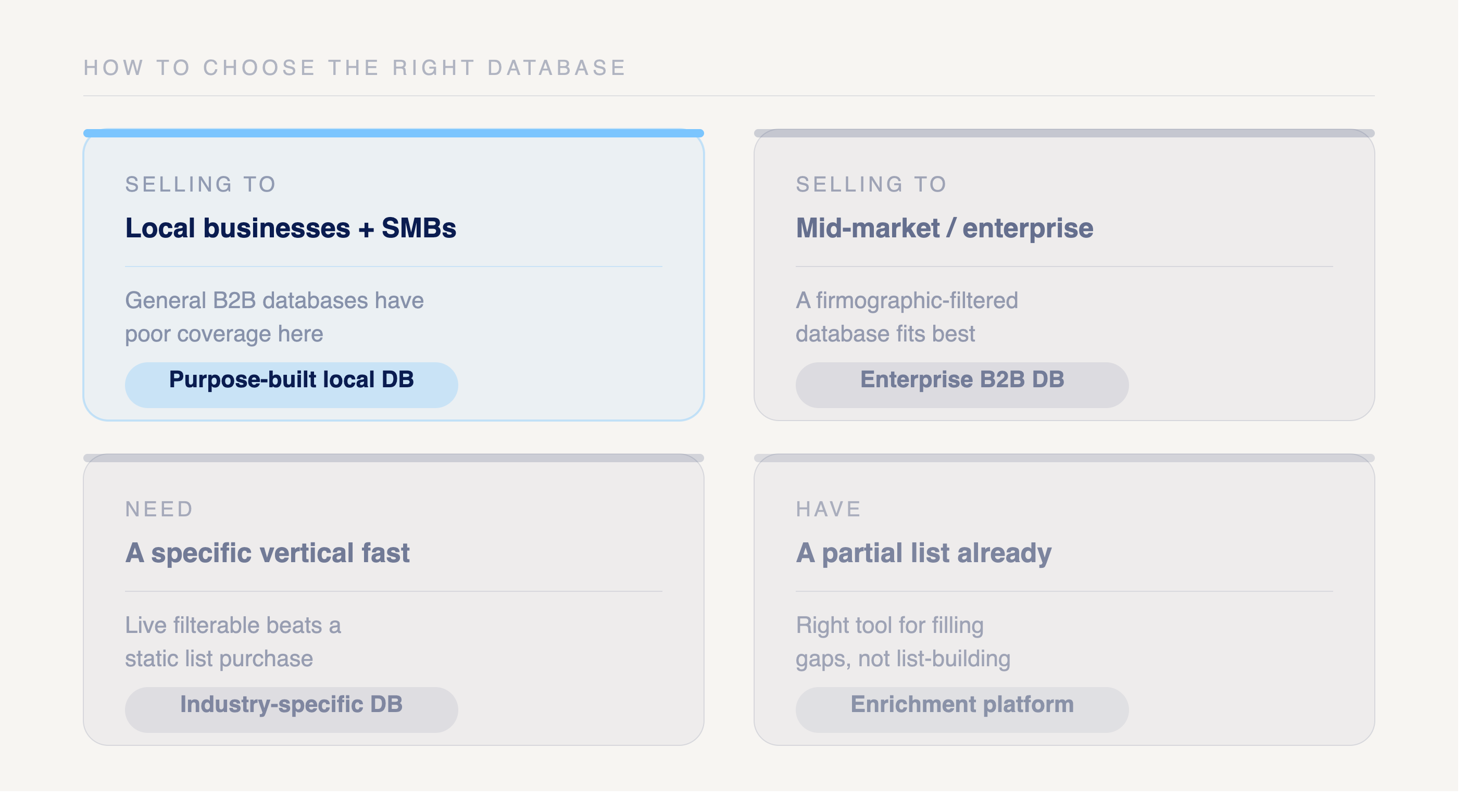
For SMB outreach targeting local businesses, Openmart is the strongest option. It covers 50M+ local business records with verified owner contacts across 300+ categories — the segment Apollo and ZoomInfo consistently miss. For enterprise B2B prospecting, Apollo and ZoomInfo remain strong options.
What is the best lead generation software for small business sales teams?
The best lead generation software for small business sales teams depends on who you're selling to. If your buyers are local business owners — restaurants, contractors, healthcare practices — Openmart delivers verified owner contacts and built-in outreach at SMB pricing. If you're targeting mid-market or enterprise accounts, Apollo or ZoomInfo are better fits.
Related: best AI Lead Generation Tools for SMB (2026) · Openmart vs ZoomInfo
Related articles

Start reaching local businesses today
No credit card required
50M+ local business databases


.png)
