.svg)
Best AI Lead Generation Tools for SMB & Local Business Outreach (2026)
Quick answer: Openmart is the most accurate tool for local SMB lead generation, pre-verifying 50M+ local business owner contacts at 97–99% accuracy before delivery. In a 1,000-record benchmark, Openmart matched 87–91% of businesses under 10 employees, versus 36–56% for Apollo and ZoomInfo. Free plan available with 200 free credits, no credit card required.
TL;DR
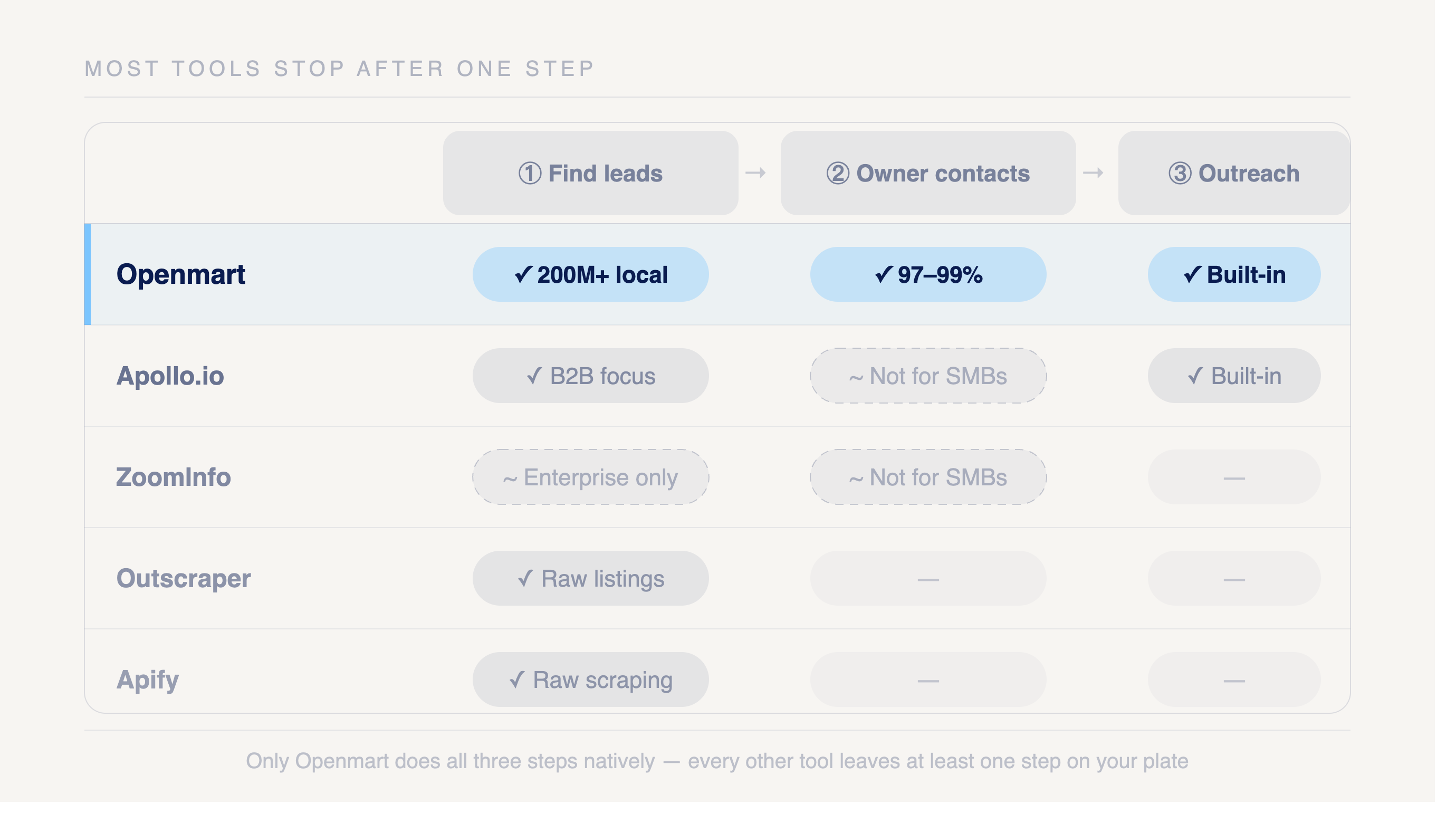
Finding and reaching local business owners requires three steps: discover the right businesses, get verified owner contacts, and run outreach. Most AI sales agents and lead generation tools stop after one step.
Openmart's Openclaw handles all three in one workflow — 50M+ local business contacts, verified owner emails at 97–99% accuracy, and built-in email sequencing. No CSV exports, no stitching tools together.
In a 1,000-record, domain-only benchmark, Apollo and ZoomInfo failed to return any contact for 36–56% of businesses under 10 employees. Openmart matched 87–91% of the same segment (see the full benchmark).
This guide is for agencies, field sales teams, and local service vendors that prospect SMB owners at scale.
The problem with AI lead generation tools for local SMBs
Finding local business leads takes three steps, and most tools stop after one. First you build a list of businesses in a category and area. Then you find a real contact for the owner or decision-maker. Then you reach out. Stitching three tools together means you export, reformat, and re-import data at every handoff, and you pay three separate bills to do it.
Scrapers like Outscraper and Apify handle the first step well. They pull listings from Google Maps and the web on demand. They stop short of verified owner contacts, and they have no outreach layer, so you still need enrichment and an email tool on top.
Apollo and ZoomInfo run the opposite direction. Both index corporate B2B contacts at companies with employee counts and funding rounds. A solo dentist, a family-owned HVAC shop, or an independent boutique either shows up with no owner contact or never appears at all.
In a 1,000-record benchmark, that gap is measurable: Apollo and ZoomInfo returned no match at all for 36–56% of businesses under 10 employees, versus an 87–91% match rate for Openmart in the same segment (see the full benchmark).
This roundup judges each tool on four things. How well it covers local SMBs, whether it gives you verified owner contacts, whether outreach is built in, and whether the pricing fits a prospector's budget rather than an enterprise one.
Best AI lead generation tools for SMB sales teams
Each tool below is scored against four criteria. Local SMB coverage, verified owner contacts, built-in outreach, and pricing accessibility. The list runs from all-in-one platforms that handle the full workflow down to single-function scrapers that cover only one step. Use the entries to match a tool to where you actually lose time, whether that point is finding leads, getting owner contacts, or running outreach.
Why Openmart is the best AI lead generation tool for local SMBs
For teams evaluating AI sales agents for automated SMB prospecting, Openmart is purpose-built for the AI lead generation workflow that SMB sales teams actually need: find the business, get the verified owner contact, send the outreach. Every step runs inside one platform, powered by AI that pre-verifies contacts before they reach your list. For teams targeting local business owners — not corporate org charts — that end-to-end automation is what separates Openmart from every other tool in this category.
Openmart
Openmart occupies a category that none of the other tools here fit cleanly. It is a local business lead database paired with an AI sales agent and built-in outreach platform. Scrapers pull raw listings and stop there. Enterprise B2B tools chase corporate org charts. Openmart does the full job for one specific audience: the people selling to local business owners.
The database covers 50M+ local businesses across 300+ SMB categories, from independent restaurants and dental offices to auto shops and salons. You filter down to the exact segment you want, then pull verified owner contacts at 97–99% accuracy. The verification happens before you ever see the record, so you skip the manual cleanup step that scraped data forces on you.
Openclaw: the AI sales agent layer
Openclaw is Openmart's AI sales agent. It sits on top of the 50M+ local business database and automates the three steps that sales teams do manually.
You give it a goal — for example, "find HVAC contractors in Phoenix who haven't been contacted recently" — and it returns a ranked list of businesses, enriched owner contacts, and draft outreach sequences ready to send.
The difference from tools like Clay or Apollo is the data underneath. Clay and Apollo index corporate B2B contacts. Openclaw runs on Openmart's local business database, so owner-level contacts for a two-person plumbing shop or an independent salon are verified and ready, not missing or stale.
Real workflows Openclaw handles:
- Prospect: Build a targeted SMB prospect list by filtering 50M+ local businesses by category, location, and size — automated contact discovery finds and verifies the owner before the list reaches you
- Enrich: Pull verified owner name, email, and phone — pre-checked before delivery
- Outreach: Generate personalized email sequences by business type and send directly from the platform
See how DoorDash, Whatnot, and Alibaba use Openclaw to run these workflows at scale.
The outreach layer is what closes the loop. Built-in email sequencing lets you go from a filtered list of local businesses to a running campaign without exporting CSVs into a separate sending tool. You find the leads, get the owner contacts, and send the outreach inside one workflow. Openmart is the only platform on this list that does all three steps natively.
The contrast with scrapers is direct. Tools like Outscraper and Apify hand you a listing dump that still needs enrichment and verification before anyone can use it. Openmart pre-verifies the owner contact, so the record is ready to email on arrival. You skip the enrichment vendor and the deliverability gamble. For a full breakdown of why raw extraction falls short, see lead scraping tools vs pre-built databases.
The contrast with Apollo and ZoomInfo is about scope and price. Those platforms index mid-market and enterprise companies, where owner-level data for a two-person plumbing business is thin or missing entirely. Their pricing assumes a corporate sales budget. Openmart is scoped and priced for the people prospecting local independents, not for sales orgs chasing Fortune 500 accounts.
Key capabilities:
- 50M+ local business records across 300+ SMB categories
- Verified owner name, email, and phone — pre-checked at 97–99% accuracy
- AI-powered prospecting: describe your target in plain language, Openclaw builds the list
- Built-in email sequencing — no separate sending tool required
- Prospect, enrich, and outreach in one workflow with no CSV exports
Pricing: Free plan available. Starter plan from $105/mo. Enterprise custom pricing.
Limitations: No native CRM integrations — contacts export via CSV rather than syncing directly to Salesforce or HubSpot. Less suited for corporate B2B prospecting where LinkedIn-style employee data matters more than owner contacts.
Best for: Vendors pitching POS systems, insurance, or supplies to local businesses. Agencies running outreach for local clients. Field sales teams working a territory of independent owners. If your buyer runs a storefront rather than a finance department, Openmart is built for your list.
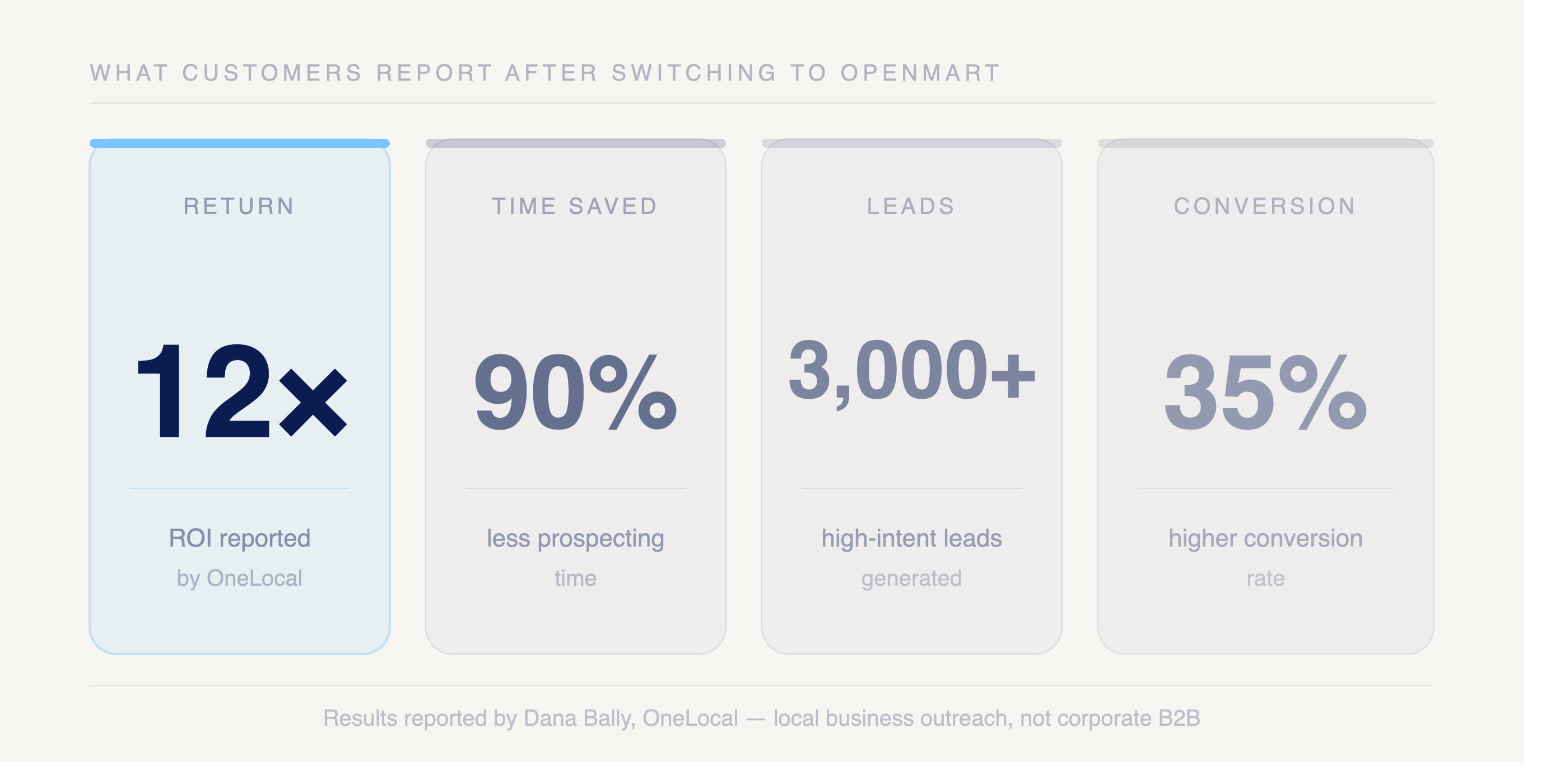
Customer proof: Dana Bally, a sales leader at OneLocal, reported a 12x return, 90% less prospecting time, 3,000+ high-intent leads, and 35% higher conversions after switching to Openmart. Sales manager Marcus D. reported the owner finder cut prospecting time by 80%. Both results come from local business outreach, not corporate B2B campaigns.
Apollo.io
Apollo.io is one of the strongest B2B prospecting platforms on the market, with a database north of 275 million contacts and built-in email sequencing that lets you find and message prospects in one place. Sales teams chasing corporate decision-makers get real value from its filters, intent signals, and outreach cadences.
The platform falls short the moment you target local businesses. Apollo indexes companies with corporate footprints, so its records skew toward firms with LinkedIn profiles, funding data, and titled employees. A two-person dental practice or an independent auto shop rarely shows up with a verified owner email.
Apollo's database holds 230m+ contacts but its SMB storefront records sit around 50m — a quarter of Openmart's coverage. Owner email accuracy for local businesses runs 70–80%, and data refreshes quarterly, meaning up to three months of ownership changes pile up before a record updates. The filters work for corporate contacts; they break down for the owner of a dental practice or an auto shop.
Owner-level contact data is the specific gap. Apollo surfaces job titles like VP of Sales or Marketing Director, not the owner-operator who actually makes buying decisions at a local SMB. When you do find a small independent, the contact accuracy drops because Apollo wasn't built to verify single-owner businesses across hundreds of local categories.
Pick Apollo if you prospect mid-market and enterprise accounts where a named buyer sits behind a company domain. Skip it if your list is local density, the neighborhood salons, contractors, and restaurants where the owner is the only contact that matters and Apollo simply doesn't carry them.
For a direct side-by-side on how Openmart and Apollo handle local SMB data differently, see Openmart vs Apollo for local business prospecting. In that same 1,000-record benchmark, Apollo returned no match for 36% of businesses under 10 employees, versus Openmart's 87–91% match rate. See the full results.
ZoomInfo
ZoomInfo sells enterprise-grade data intelligence, and the pricing reflects it. Annual contracts run into the tens of thousands, with seat minimums and tiered add-ons that put the platform out of reach for most local prospecting budgets. You pay for depth on corporate accounts, firmographics, intent signals, and org charts that map decision-makers inside mid-market and enterprise companies.
Pricing is enterprise-tier with annual contracts, seat minimums, and tiered add-ons that put the platform out of reach for most local prospecting budgets. There is no self-serve option — you go through a sales process before seeing a number. For a direct comparison on SMB data coverage, see Openmart vs ZoomInfo.
That depth thins out fast when you point ZoomInfo at local businesses. Coverage skews toward established companies with registered filings and digital footprints, so a single-location dental practice or a family-owned HVAC shop often returns sparse or stale records. Owner-level contacts for micro-businesses are inconsistent, and the verification that holds up for a 500-person company breaks down for a sole proprietor running everything from a personal cell.
The platform also stops at data. You export contacts, then move them into a separate tool to run sequences, which adds a step ZoomInfo never closes for you.
Best for large sales organizations with the budget to match and a focus on corporate accounts. For finding and reaching local business owners at scale, the cost and the coverage gap make it overkill.
Outscraper
Outscraper pulls business listings from Google Maps and the web on demand. It is a scraper, not a lead database. You feed it a search query like "dentists in Austin" and it returns the public listing data Google already shows. Name, address, phone, website, reviews, and hours.
That output gets you partway through the find step and no further. Outscraper does not pre-verify owner contacts, so the email and phone fields you get are the generic front-desk details on the listing, not the decision-maker's direct line. There is no built-in outreach either. Once the CSV downloads, you still need an enrichment tool to find owner contacts and a separate sending platform to run sequences.
The pricing follows a pay-per-result model, which suits the one-off pull it is designed for. A technical user who wants 2,000 raw listings for a single market can get them fast and cheap.
Best for one-off data pulls by people comfortable cleaning and enriching the export themselves. If you need verified owner contacts and want to email those owners without stitching three tools together, Outscraper leaves most of the workflow on your plate.
For a full breakdown of the difference between raw scraping and a pre-built database for outreach use cases, see lead scraping tools vs pre-built databases. If you need verified owner contacts after pulling raw listings, the best contact data enrichment tools for SMB covers your next step.
Apify
Apify is a developer-oriented scraping platform that runs pre-built "actors" to pull business data from sources like Google Maps and company directories. Engineers and technical agencies use it to build custom data pipelines that fit a specific schema. The flexibility is real. You can scrape almost any public site if you know how to configure and maintain the scripts.
The gaps show up the moment you need finished leads rather than raw data. Apify extracts listings, but it does not verify owner contacts, so you still run extracted emails and names through a separate enrichment step. It also has no outreach layer, which means you export everything and load it into another tool to send a single email.
The setup cost is the bigger problem for most local prospecting teams. Configuring actors, handling proxies, and cleaning output takes engineering time that a sales or agency team rarely has. For a deeper breakdown of why raw extraction falls short of a maintained database, see scraping tools versus pre-built databases.
Best for developers and agencies that want raw data pipelines and already own their enrichment and outreach stack elsewhere.
Comparison table: local business lead generation tools
The four criteria from this roundup map to four columns. Scan the rows to see where each tool covers the full find-contact-outreach workflow and where it stops short.
ToolFree PlanStarting PriceAI Sales AgentLocal SMB CoverageVerified Owner ContactsBuilt-in OutreachBest ForOpenmartYes (200 free credits, no credit card)$105/mo (Starter plan)✓50M+ businesses, 300+ categories✓ 97–99% accuracy✓ Email sequencingLocal business outreach at scaleApollo.ioYes (900 annual credits)$49/moPartialSparse for local SMBsLimited for independents✓Mid-market B2BClayYes (500 actions/mo)$167/moPartialCorporate-focusedRequires enrichment setupVia integrationsTech-savvy B2B teamsZoomInfoNo~$15,000/yr✗Skews to established companiesInconsistent for micro-businesses✓Enterprise sales orgsOutscraperYes (500 records/mo)$3/1,000 records✗On-demand listings only✗✗One-off data pullsApifyYes ($5/mo prepaid, no credit card)$29/mo✗Raw scraped data✗✗Developer data pipelines
Openmart is the only row that says yes across all three workflow steps at an SMB price point.
AI-Powered Automation: Openmart ✓ AI contact verification + automated sequencing | Apollo.io Partial (outreach automation, no local SMB AI) | ZoomInfo Partial (intent signals only, no outreach) | Outscraper ✗ | Apify ✗
Why most AI lead generation tools miss local SMB owners
Apollo and ZoomInfo build their buying signals around corporate infrastructure. They track funding rounds, job changes, and technology install events because those signals predict enterprise software deals. A plumber, a taco shop, and a hair salon generate none of these. Their owners do not announce a Series b or trigger a job-change alert.
Local business owners stay invisible to these systems for structural reasons. They have no LinkedIn title that reads "Owner of Luigi's Pizza," no public funding event, and no corporate email domain to scrape. The Google Maps API caps results at 60 places per search and returns zero contact data, so it cannot fill the gap either.
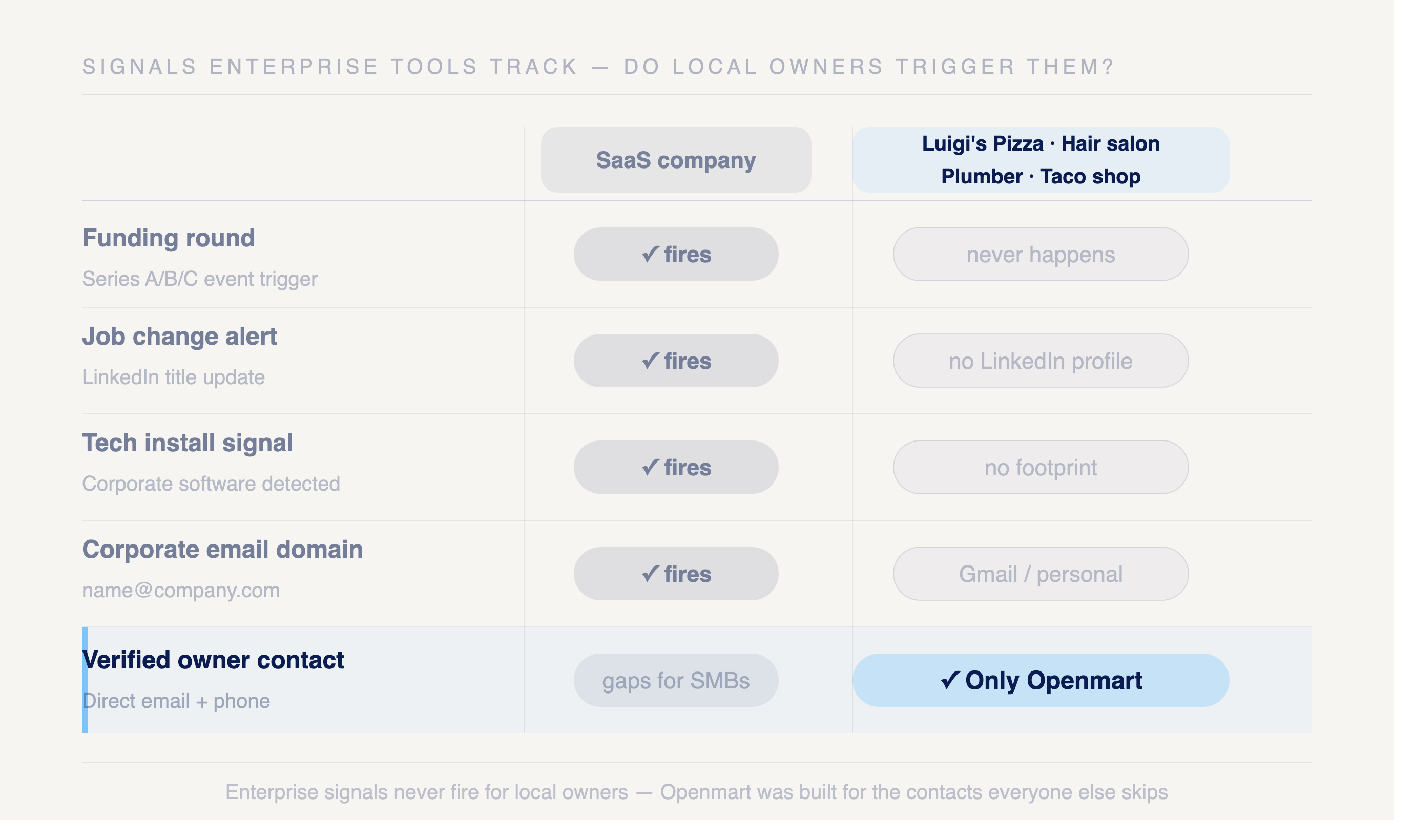
Openmart was built for the contacts everyone else skips. A single lookup returns the owner's personal email, direct phone, tech stack, and revenue estimate. The database covers 50M+ local business listings across 300+ industry categories with 97–99% stated accuracy (local-business-enrichment). Pricing runs on credits with no seat contracts and no annual minimum, so a solo agency owner and a 50-rep sales team pay the same per valid match.
Live web search vs. pre-verified databases: what the accuracy data actually shows
Some newer tools skip static databases entirely and search the live web at query time. That approach has a real edge for one-off lookups on businesses that haven't been indexed anywhere yet — a business that just opened last week, for example.
The tradeoff shows up in accuracy and speed. Live web search tools re-verify every contact at the moment you run a query, and independent testing of this approach has shown accuracy rates in the 70–75% range. Openmart pre-verifies contacts before they ever reach a search result, which is how it holds a 97–99% accuracy rate — the checking happens once, upstream, instead of on every query.
For a single lookup, that difference may not matter much. For a sales team running outreach at volume — hundreds of contacts a week — waiting on a live crawl to re-verify each record, at a lower accuracy rate, adds up fast. A pre-verified database returns results instantly and holds a consistently higher match rate.
How to choose the right tool for your workflow
Match the tool to where your workflow breaks down, and to who you're actually selling to.
You sell to local business owners — restaurants, contractors, salons, dentists, HVAC shops Openmart with Openclaw is the only option with a purpose-built database of verified local business owner contacts. Every other tool on this list was built for corporate B2B and will return missing or generic contacts for independent SMBs. The end-to-end workflow — prospect, enrich, outreach — in one platform means no stitching tools together. For a practical guide on reaching this audience, see how to effectively reach out to local business owners and the best cold email strategy for selling to local businesses.
You prospect mid-market and corporate B2B accounts Apollo.io for teams that want a database and sequencer at an accessible price. Clay for teams with technical resources who want full control over a custom enrichment pipeline. Both require a separate sequencer unless you use Apollo's built-in outreach. The broader landscape is covered in B2B data providers for SMB prospecting.
You already have a lead source and only need cleaner contacts A dedicated enrichment layer makes more sense than paying for a full platform. The best contact data enrichment tools for SMB compares the options for that narrower job.
You need raw data for a one-off project and have technical resources Outscraper for Google Maps listing data. Apify for custom scraping pipelines. Both stop at raw data — plan for enrichment and outreach as separate steps. See common mistakes to avoid with lead generation for what typically goes wrong when teams stitch too many tools together.
You're evaluating enterprise-grade data intelligence for a large sales org ZoomInfo for established companies with the budget to match. Not suitable for local business prospecting at any price point. For a direct comparison on SMB coverage, see Openmart vs ZoomInfo.
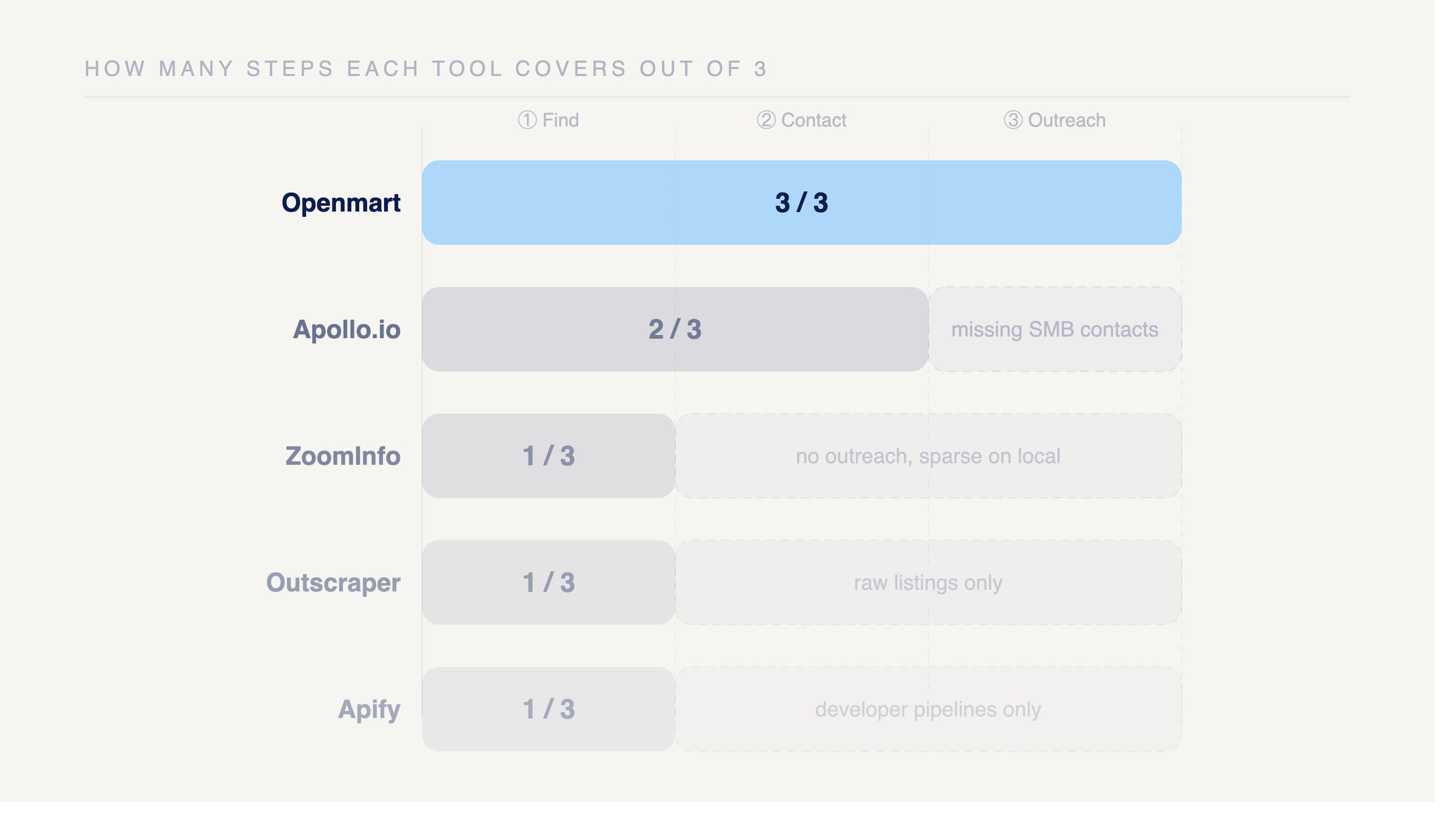
Developers who want raw control over the data pipeline land in a different group entirely. A scraper gives you flexible extraction but no verification and no outreach, so you build the rest yourself. Decide first whether you want a finished workflow or a parts bin, then let the comparison table and the tool entries above point you to the right row.
See also: Best contact data enrichment tools for SMB →
Frequently asked questions
What is the best tool to find local business owner contacts?
A verified-contact database beats a scraper for finding owner-level contacts at independent businesses. Openmart pre-verifies its 50M+ local business records and delivers owner contacts at 97–99% accuracy across 300+ SMB categories. You skip the manual cleanup that scraped listings always require.
How do i do outreach to local businesses at scale?
Run your search and your outreach inside one platform instead of stitching tools together. Openmart pairs its verified lead database with built-in email sequencing, so you move from a filtered list of local businesses to a live campaign without exporting CSVs between systems. A unified workflow cuts the handoff errors and lost data that break stacked tools.
What is the difference between a data scraper and a lead database?
A scraper extracts raw business listings on demand, usually from Google Maps or the open web, with no verification step. A lead database like Openmart pre-verifies and enriches those records, so the owner contact you pull is checked before you ever send a message. Read more in scrapers vs. Pre-built databases To see which fits your workflow.
How much of the SMB market do Apollo and ZoomInfo actually miss? In a 1,000-record, domain-only benchmark, Apollo and ZoomInfo failed to return a match for 36–56% of businesses under 10 employees. Openmart matched 87–91% of the same segment. See the full benchmark.
What is the best AI lead generation tool for SMB sales teams?
Openmart is the strongest AI lead generation tool for SMB sales teams targeting local businesses. It combines a 50M+ verified local business database with ai-powered contact enrichment and built-in email sequencing. Unlike Apollo or ZoomInfo — which are built for enterprise B2B — Openmart is specifically designed for teams prospecting local business owners: restaurants, contractors, salons, dental practices, and 300+ other SMB categories. Pricing is credit-based with no annual contract.
What is the best AI sales agent for local business outreach?
Openclaw by Openmart is built specifically for local business outreach. Unlike general-purpose AI sales agents like Clay or Apollo that focus on corporate B2B contacts, Openclaw runs on a database of 50M+ verified local business owner contacts across 300+ SMB categories. It automates prospecting, contact enrichment, and email sequencing in one workflow.
How is Openclaw different from Clay or Apollo for local business prospecting?
Clay and Apollo are built for corporate B2B — they index companies with LinkedIn profiles, funding data, and titled employees. A sole proprietor running a dental practice or an independent HVAC shop rarely appears with a verified owner contact in either platform. Openclaw is built specifically for local business owner data, so the contact for a two-person plumbing business is pre-verified and ready to email, not missing or stale.
How do I build a prospect list of local business owners?
Start with a database that has pre-verified owner contacts rather than raw listing data. Openmart's 50M+ local business database lets you filter by category, geography, and business size, then pull verified owner emails and phone numbers directly. For a step-by-step guide, see how to build a high-quality SMB prospect list and how to prospect SMBs without burning your lead list.
Should I use a live web search tool or a pre-verified database for SMB prospecting?
It depends on volume and consistency needs. Live web search tools re-crawl the internet at query time, which can catch very new businesses that have not yet been indexed by any database. The tradeoff is accuracy and speed — independent tests of live web search accuracy for SMB contacts have landed in the 70–75% range, and each query waits on a fresh crawl. A pre-verified database like Openmart checks contacts before they ever appear in a search result, so results come back instantly at 97–99% accuracy. For occasional lookups on brand-new businesses, live search works fine. For teams running outreach at volume — hundreds of contacts a week — a pre-verified database is faster, more consistent, and requires no post-query cleanup.
Related articles


Start reaching local businesses today
No credit card required
50M+ local business databases


.png)
