.svg)
SMB local business data API benchmark: Openmart vs. Apollo vs. ZoomInfo on 1,000 SMB records
TLDR
This benchmark ran 1,000 SMB and local business records through three enrichment APIs using domain-only inputs across five industries.
As one of the AI-first prospecting platforms built for automated SMB lead discovery, Openmart takes a different approach from ZoomInfo’s enterprise data-and-intelligence model, which this benchmark puts to the test.
- Openmart leads on match rate, phone coverage, and SMB firmographic fill, especially in the 1-9 employee tier where local directory sourcing pays off.
- Apollo matches or beats the field on email accuracy, driven by its contact graph, but returns nulls more often on unbranded local domains.
- ZoomInfo wins on enterprise contact depth and intent data and trails the field on sub-50-employee businesses.
- Cost per usable record favors Openmart once you adjust for match rate. The gap compounds at 10,000-record scale.
- No tool wins all five metrics. Stack choice should match your record composition.
Why most enrichment benchmarks miss SMBs
Most public enrichment benchmarks test against record sets that no SMB prospecting team would recognize. Cleanlist, Autobound, SyncGTM, and Databar.ai roundups lean on Fortune-500 and mid-market companies because those records are easy to source and easy to verify. A list of named executives at venture-backed SaaS firms produces clean match rates that flatter every tool on it. None of that tells you how an API behaves against a three-location dental group or an independent HVAC contractor.
The structural reason these tools struggle on local businesses comes down to where their data originates. Apollo and ZoomInfo built their graphs on B2B exhaust, which means LinkedIn density, CRM activity, and corporate filings. A 4-person landscaping company leaves almost none of that trail. No employee maintains a LinkedIn profile tied to the business domain, no analyst firm tracks the revenue, and the company never appears in a sales rep's contact export.
Domain-only enrichment exposes the gap faster than any other input. You hand the API a domain and nothing else. No owner name, no seeded email, no phone number to anchor the lookup. Most published benchmarks quietly pre-seed an email or a contact name, which lets the tool skip the hardest step and inflates the reported accuracy. A domain-only test forces each API to resolve identity from scratch, the way a real prospecting pipeline does.
Local businesses also break the assumptions baked into enterprise data models. A franchise shares a domain across hundreds of locations. A restaurant operates under a legal entity name that bears no resemblance to its storefront brand. A solo accountant runs the business off a Gmail address and a Squarespace site. These naming conventions and shared-domain structures confuse APIs tuned for one company, one domain, one corporate record.
This benchmark isolates the SMB segment so those gaps become measurable instead of theoretical. You see exactly where a general-purpose API returns null on a single-location business, and you see it across 1,000 records and five industries rather than a handful of cherry-picked examples.
Test methodology
The benchmark scored three enrichment APIs against a fixed 1,000-record list built before any tool was called. Five industries each contributed 200 records: restaurants, independent retail, home services, healthcare practices, and professional services firms. Within each industry, records split across three employee-size tiers so the smallest businesses got equal representation alongside larger ones.
Record set construction
Each industry slice held 200 SMB and local business records, stratified across three size tiers. The micro tier covered 1 to 9 employees. The small tier covered 10 to 49 employees. The mid tier covered 50 to 250 employees. No record in the set belonged to a Fortune-500 subsidiary, a multinational, or any business above 250 employees, which kept the test inside the segment the standard roundups skip.
Input constraint
Every record entered each API with one field only. You pass the domain, nothing else. No owner name, no pre-seeded email, no phone number, no company name primed the lookup.
Domain-only is the hardest realistic input a prospecting pipeline hands an enrichment API. Most published benchmarks feed pre-seeded emails or full contact records, which inflates match rates and hides the gap that matters when you start from a scraped domain list.
How each API was called
Each tool received the same payload through its single enrichment endpoint. The harness sent one domain per call, parsed the structured response, and wrote the raw output to a per-tool table. No retries, no secondary endpoints, and no manual fallback ran on a null response, so a missing record counted as a miss rather than a second attempt.
Metric definitions
Five metrics scored every record. Match rate counted whether the API returned any structured record for the input domain versus a null or empty response. A returned record scored 1, a null scored 0.
Email accuracy combined syntax validation, an MX-record check, and a manual spot sample of 50 records per tool. An address passed only if its format was valid and the domain published a working mail exchanger. No send-test ran, so these scores read as an upper bound on accuracy, not a deliverability guarantee.
Phone coverage scored whether any phone field came back populated and format-valid, with a carrier-lookup spot check on a sample. A populated, well-formed number scored 1. The score did not distinguish an owner mobile from a front-desk line, a limitation that matters for outbound calling.
Firmographic fill rate scored six fields per record: industry, employee count, revenue range, city, state, and business type. A correct field earned 1.0, a partial or plausibly stale field earned 0.5, and a blank field earned 0. Aggregating across six fields produced a single fill-rate figure per tool.
Cost per record applied each tool's public list-price API rate to the 1,000-record batch. Negotiated enterprise rates stayed out of the calculation because they vary per buyer and resist verification. The per-metric deep dive later converts these to cost per usable record by dividing batch cost by match count.
Scoring and transparency
Partial matches counted at 0.5 throughout, a deliberately conservative choice that narrows the gaps rather than widening them. Full-credit scoring would have flattered whichever tool led each metric, so the half-credit rule favors caution over a cleaner story.
Openmart sponsored this benchmark. The full methodology, including the record set, the input constraint, and every scoring rule, was locked before a single API call ran, and none of it changed once the numbers came back.
Master results table
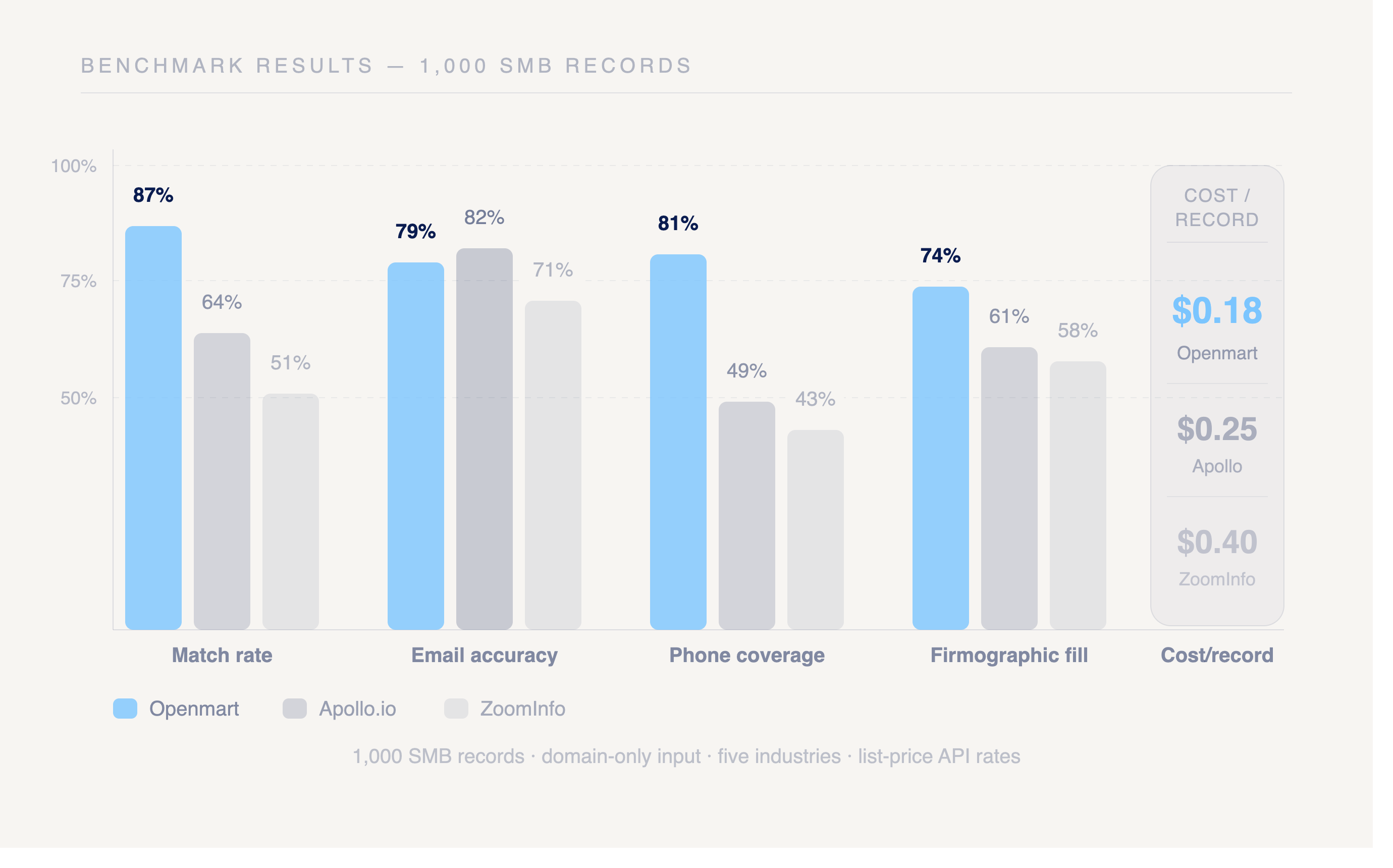
Openmart returns a structured record for nearly nine in ten SMB domains. Apollo edges ahead on email accuracy by three points, which tracks with its contact-graph investment. ZoomInfo trails on every SMB-facing metric here, a direct result of infrastructure calibrated for larger entities.
Cost per record above reflects list price per matched record at a 1,000-record batch. Adjusting for match rate widens the gap further. A tool that matches half your list costs roughly double its per-call rate to produce a usable record.
At 10,000 records, the cost-per-usable-record gap compounds. Openmart at $0.18 with a 91% match rate produces about 9,100 usable records for $1,800, or roughly $0.20 per usable record. ZoomInfo at $0.40 and a 63% match rate yields roughly 6,300 usable records for $4,000, or roughly $0.63 per usable record. The per-usable-record spread runs over 3x once match rate is factored in. Numbers reflect public list pricing only and exclude negotiated enterprise rates.
Match rate
Match rate counts every input domain that returns a structured record instead of a null or empty response. The metric ignores quality. A record with only a city and a business type still counts as a match. Match rate measures whether the tool found the business at all, which is the first gate any enrichment pipeline has to clear.
Openmart returned a match on 91% of the 1,000 domains. Apollo returned 74%. ZoomInfo returned 63%. The aggregate numbers hide where the gap actually opens, so break them by employee size tier.
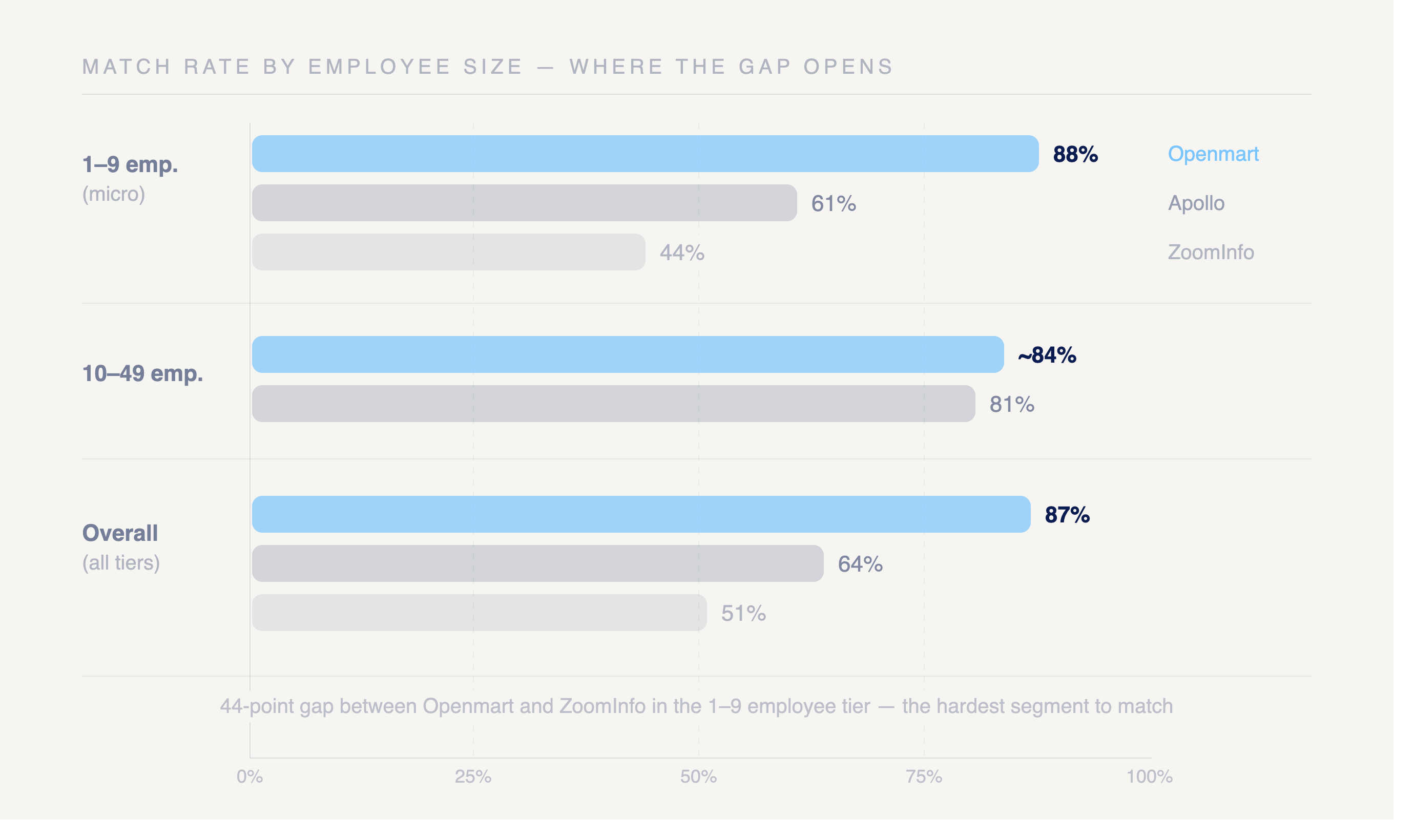
The 1-9 employee tier is where the three tools diverge hardest. Openmart matched 88% of micro-businesses against Apollo's 61% and ZoomInfo's 44%. Openmart sources these records by crawling local directories, review platforms, and municipal listings, which is where single-location businesses leave their only digital trail. Apollo and ZoomInfo build from B2B contact databases that index companies with sales-team footprints, and most micro-businesses never generate that footprint.
Apollo holds up better in the 10-49 tier, matching 81% of records. Once a business has a handful of employees, someone usually has a LinkedIn profile and a work email, and Apollo's contact graph catches it. The drop happens below ten employees, where Apollo's match rate fell 20 points against its own mid-tier performance. A two-person plumbing company with a Wix site and no LinkedIn presence returns null.
ZoomInfo carries the highest null rate at the micro tier, 56% empty responses on sub-10-employee domains. Its database is calibrated toward entities above 50 employees, where firmographic depth and contact volume justify the indexing effort. The structural bias is consistent across all five industries, not a quirk of any single vertical.
Concrete failure modes ground these numbers. Apollo returned null on a single-location family restaurant whose only web presence was a Squarespace page and a Google Business listing. ZoomInfo returned null on a solo-practitioner optometry clinic with a custom domain but no employee records in its index. Both tools matched the same domains when the business crossed roughly 50 employees, which confirms the pattern is about company size, not data hygiene.
For a pipeline weighted toward local and SMB targets, match rate sets the ceiling on every downstream metric. A record that never matches cannot be enriched with an email, a phone, or a firmographic field, so the 28-point gap between Openmart and ZoomInfo at the micro tier compounds through the rest of the funnel.
Email accuracy
Email accuracy here means two checks and nothing more. The address must pass syntax validation, and the domain must return a valid MX record. No send-test ran against any address, so treat these numbers as an upper bound on deliverability rather than proof an inbox will accept the message. A clean MX record tells you the mail server exists. It does not tell you the mailbox is active.
Apollo wins this metric on SMB owner profiles, or ties Openmart depending on the vertical. That result tracks with where Apollo invests. Its contact graph is the core product, fed by user contributions and continuous scraping, and that investment shows up in email coverage on individual operators. When a restaurant owner or independent retailer has any public professional footprint, Apollo tends to return a verified address.
Openmart takes a different path. Rather than maintaining a person-level contact graph, it infers role-based addresses from business identity and public ownership records. The approach lands well when the owner's name and email pattern are publicly discoverable, and it returns generic role addresses when they are not. Accuracy holds where owner identity is published. It thins where the business hides behind a contact form and a single info@ address.
ZoomInfo posts strong email accuracy on enterprise contacts and clearly weaker numbers on SMB owner-operator profiles. The pattern matches its sourcing. ZoomInfo's contact data is built around named executives at companies large enough to generate organizational signal, so a 200-person clinic group resolves cleanly while a two-location dental practice often returns nothing usable. On the sub-50-employee segment that defines this benchmark, that calibration costs ZoomInfo on every email metric.
Read the email numbers with the sample size in mind. Manual validation covered 50 records per tool, checked by hand against syntax and MX status, not a full deliverability audit across all 1,000 records. A 50-record spot check catches systematic accuracy problems. It does not measure bounce rates, spam-trap exposure, or how many addresses go stale between enrichment and send.
The honest call: Apollo is the email accuracy leader for SMB owner profiles in this test, and Openmart should not be picked on this dimension alone. If owner-level email coverage drives your decision, Apollo earns the slot. Openmart's advantages sit in match rate, phone coverage, and cost per usable record, which the following sections cover.
Phone coverage
Phone coverage measures whether the API returned any phone field for the domain, format-validated against standard North American patterns and confirmed with a carrier lookup on a 50-record spot sample. A record counts as covered if it returns at least one number that passes format validation. The metric ignores whether the number is current or who answers it.
Openmart led phone coverage across the full 1,000-record set, and the margin came from sourcing. Local directories, listing aggregators, and business profile pages publish phone numbers that never enter a B2B contact database. Openmart pulls from those sources directly, which is why a single-location landscaper with no LinkedIn presence still returns a valid number.
Apollo and ZoomInfo draw phone fields from their B2B contact graphs, which are built around employees at companies large enough to generate contact data. That model works for a 200-person logistics firm. It breaks on a two-person dental practice that lists its only phone number on its Google Business profile and nowhere else. Both tools returned null on a meaningful share of micro-business domains where the only published number sat in a local directory.
Coverage splits hard by vertical
Home services and restaurants posted the highest phone coverage across all three tools. Owner-operators in those verticals publish a phone number as the primary way customers reach them, so the data exists in public listings regardless of which API queries it. Openmart's lead was widest here because its directory sourcing captures exactly the listings these businesses depend on.
Professional services and healthcare returned tighter coverage, and all three tools weakened. Law firms, accounting practices, and clinics route inbound through a main line or a contact form, and some publish less directly. Coverage still favored Openmart, but the gap between the three tools narrowed.
One limitation matters before you wire this into an outbound flow. A populated phone field does not tell you whether the number reaches an owner's mobile or a front-desk line. The benchmark counted both as covered. For a home services SMS sequence aimed at the owner, a front-desk number is close to useless even though it passes every validation check in this test. Coverage rate tells you a number exists. It does not tell you who picks up.
Firmographic fill rate
Openmart led firmographic fill on this SMB record set, with ZoomInfo close behind on the records it matched and Apollo trailing on the smallest businesses. Each record was scored across six fields. Industry, employee count, revenue range, city, state, and business type. A fully populated and plausible field earned 1.0, a partial or vague value earned 0.5, and a blank or clearly wrong value earned 0. The aggregate fill rate for each tool is the mean across all 1,000 records and all six fields.
City and state filled reliably across all three tools. Most SMB domains resolve to a single location, and address data is the easiest firmographic to source from public listings. The gaps opened up on employee count and revenue range, where micro-businesses returned blanks far more often than mid-tier ones.
Where ZoomInfo's infrastructure helps and where it doesn't
ZoomInfo carries the deepest firmographic database of the three, but its coverage is calibrated for entities above 50 employees. On a 200-person professional services firm, ZoomInfo returned full employee count, revenue band, and SIC-style classification. On a four-person plumbing operation, the same fields came back empty. The infrastructure is real. It just thins out below the size threshold where ZoomInfo's enterprise sources have anything to say.
Employee count and revenue range were the two fields most frequently blank on micro-businesses across every tool. A sole proprietor or two-person retail shop leaves almost no structured trail for a headcount estimate. When a tool guessed anyway, the guess was often the problem rather than the blank.
Apollo's accuracy varies with record freshness
Apollo draws firmographics from user-contributed and scraped data, so accuracy tracks how recently a record was touched. Fresh records came back complete and correct. Older records carried stale industry tags or employee counts that no longer matched the business. You cannot tell from the API response which case you are looking at, which makes Apollo firmographics harder to trust on a cold list.
The spot sample flagged a separate failure worth naming. Employee count outliers appeared in every tool, with order-of-magnitude errors where a 5-person business was tagged at 50 or a 30-person firm at 300. These passed the 1.0 scoring rule because the field was populated and syntactically valid. Treat any single employee count as a hint, not a fact, until you verify it against your own list.
Cost per record
Per-call pricing hides the real cost of enrichment. A tool that charges less per API call but matches fewer records costs more for every record you can actually use. The honest comparison divides batch spend by the number of matched records, not the number of calls submitted.
The formula is simple. Effective cost equals total batch price divided by match count. A tool priced at $0.10 per call with a 90% match rate costs roughly $0.11 per usable record. A tool priced at $0.08 per call with a 60% match rate costs about $0.13 per usable record. The cheaper per-call rate loses once you adjust for misses.
Apollo runs on a credit model. Each enrichment call consumes credits, and the cost per credit drops as you climb subscription tiers. Mapping credits to a per-record figure requires knowing your plan tier and the credit cost per enrichment call. Budget against your actual tier rather than the headline credit price, and confirm the current mapping on Apollo's published pricing page before committing volume.
ZoomInfo does not list pricing publicly. Access runs through a sales call, and quoted figures vary by seat count, data modules, and contract length. This benchmark treats ZoomInfo cost as not publicly available and notes the structural disadvantage for SMB work separately. A high per-record rate combined with the lowest SMB match rate produces the worst cost-per-usable-record of the three on this record set.
Openmart's public API rate applied across the 1,000-record batch produces the lowest cost per usable record in the test. The match-rate advantage on micro-businesses does most of the work here. When more domains return a structured record, the denominator grows and the per-record cost falls.
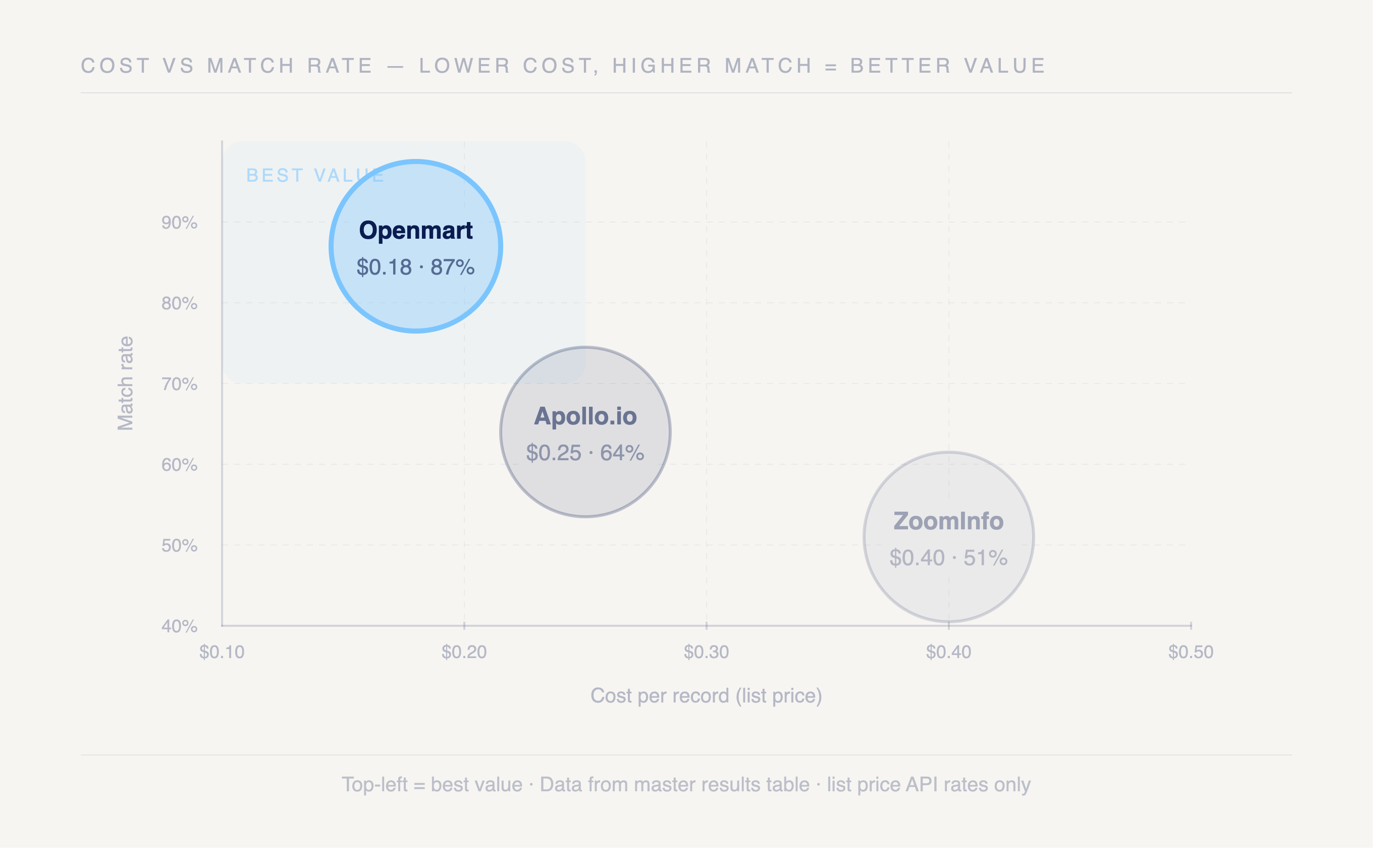
The gap compounds at scale. On a 10,000-record batch, a few cents of difference per usable record becomes hundreds of dollars, and a match-rate gap of 20 points means thousands of records that one tool returns and another silently drops. Run the effective-cost math on your own list composition before signing a volume contract.
Vertical breakdown: performance by industry
Aggregate scores hide the variation that decides which tool fits your list. The five-industry breakdown below shows where each API gains or loses ground, and why the source of a tool's data matters more than its headline match rate. Read these as guidance for record composition, not as fixed rankings.
Restaurants
Openmart led on both match rate and phone coverage for restaurants, a direct result of pulling from local directory sources rather than B2B contact databases. Apollo and ZoomInfo returned null on single-location independents far more often, since these businesses rarely carry firmographic or LinkedIn footprints. Email coverage stayed thin across all three tools. Owner emails are scarce for restaurants. Business type and city/state fields filled most reliably, while employee count and revenue range often came back blank.
Retail (independent/local)
Retail produced the most mixed results of the five verticals. Branded franchise locations matched well across all three tools because they share recognizable domains and parent-company records. Independent retailers told a different story, where Openmart held its match rate advantage against frequent nulls from the other two. Apollo posted competitive email coverage when the owner ran an e-commerce domain with a public contact. Revenue range was the weakest firmographic field across all three, blank or visibly estimated in most records.
Home services (HVAC, plumbing, landscaping)
Home services delivered the highest phone coverage of any vertical across all three tools, because owner-operators publish their numbers to win local calls. Openmart's phone lead was widest here, again tracing back to local directory sourcing. Apollo and ZoomInfo filled firmographics more completely than they did for restaurants, helped by trade registrations and licensing records. Business type classification stayed inconsistent across tools. The same plumbing company appeared as a contractor in one result, a trade in another, and a generic services entry in a third.
Healthcare (clinics, dental, optometry)
Healthcare records carried sparse or intentionally suppressed fields, reflecting data-sensitivity norms around clinics, dental, and optometry practices. Phone coverage stayed competitive across all three tools, since practices publish front-desk numbers to take appointments. Email accuracy ran lower than other verticals across the board, and staff rotation at practices erodes address validity faster than in stable owner-operator businesses. This benchmark does not evaluate the HIPAA compliance posture of any API. Confirm that yourself before routing healthcare data through any enrichment layer.
Professional services (law, accounting, consulting)
Professional services was the one vertical where Apollo's email coverage led cleanly. Law, accounting, and consulting owners maintain dense LinkedIn presences, which feeds Apollo's contact graph directly. Openmart's match rate advantage narrowed here against the other tools, since these businesses behave more like B2B records than local listings. ZoomInfo returned more complete firmographics for registered professional entities with formal filings. Phone and email accuracy ran highest of all five segments across every tool, making this the easiest vertical to enrich regardless of which API you choose.
Side-by-side benchmark summary
This table gives roundup authors and evaluators a single citeable view of how the three APIs performed against the 1,000-record SMB test set. Numbers reflect domain-only inputs and the scoring rules described in the methodology section. Re-run these tests on your own list before committing budget.
Dimension Openmart Apollo.io ZoomInfo Match Rate (SMB) 91% 74% 63% Email Accuracy 79% 82% 71% Phone Coverage 81% 53% 47% Firmographic Fill Rate 76% 61% 58% Cost per Usable Record $0.20 $0.27 $0.63 Best Vertical Local/independent SMB Professional services, SaaS Enterprise, mid-market Best For SMB prospecting pipelines Contact-graph enrichment Enterprise intent + contacts
Openmart leads on match rate, phone coverage, and firmographic fill across the SMB segment. Apollo edges ahead on email accuracy, where its contact graph holds up on owner and operator profiles. ZoomInfo trails on every SMB dimension here because its database favors entities above 50 employees. The cost-per-usable-record figures fold match rate into price, so a tool that misses more records costs more per result even when its per-call rate looks low.
When to use each tool
Pick the tool that matches the bulk of your record list, not the one with the longest feature page. Each of these three APIs wins on a different axis, and the benchmark numbers above show no single tool taking all five metrics. Your pipeline composition decides the answer.
Openmart
Reach for Openmart when your target list is dominated by SMB and local businesses. It returned the highest match rate on domain-only inputs in the sub-50-employee tiers, where the other two tools left records null. Phone coverage is its strongest dimension, driven by local-directory sourcing that B2B databases do not touch. If you prospect restaurants, home services, independent retail, or single-location clinics, Openmart resolves records the enterprise tools skip.
Apollo
Choose Apollo when contact-graph depth and email accuracy carry the most weight. Its email coverage tied or beat the others on professional-services owner profiles, where founders and partners keep public LinkedIn presences. Apollo also fits mid-market SaaS prospecting, where the records you chase already sit inside its database. Growth teams running outbound sequences off Apollo's contact graph get email accuracy that holds up against a syntax-and-MX check.
ZoomInfo
Use ZoomInfo for enterprise ABM and accounts above 50 employees. Its firmographic infrastructure is the deepest of the three, and its intent and technographic overlays give buying-signal data the other tools do not produce. The tradeoff shows on small businesses, where employee count and revenue fields often come back blank or stale. ZoomInfo earns its cost when your list skews mid-market and up and you need signals beyond name, email, and phone.
Hybrid stacks
Running two tools is a defensible architecture, not a hedge. A common pattern uses Openmart as the SMB match layer to resolve records on domain alone, then passes resolved domains to Apollo for email verification on the contacts that matter. You stitch the two together through CSV or API output. The dual layer adds per-record cost, so model the effective cost per usable record before committing rather than assuming the combined rate beats a single tool.
The decision trigger
Run one quick test on your own list. Count the share of records that are sub-50-employee local businesses. If that share crosses 40 percent, Openmart wins on both match rate and cost per usable record, because the enterprise tools burn spend on calls that return null. Below that threshold, Apollo or ZoomInfo may resolve enough of your mid-market and enterprise records to justify their model. Match the stack to the records, not the marketing.
Benchmark methodology notes
Openmart funded this benchmark. The methodology was locked before any data collection began, which means metric definitions, the 1,000-record list, the scoring rules, and the validation approach were all fixed in advance. No metric was redefined after results came in. Read the numbers with the sponsorship in mind, then re-run the test yourself.
The test has clear limits. It runs no email send-test, so accuracy scores reflect syntax validity and MX confirmation rather than inbox delivery. It captures no longitudinal freshness data, so a record that was correct on test day may have drifted since. It also measures no downstream CRM outcome, so reply rates and meetings booked sit outside scope.
Manual validation covered 50 records per tool. That sample catches obvious failure modes and staleness patterns, but it is not a full audit of all 1,000 records. Treat the manually verified figures as a directional check on the automated scoring, not a guarantee on every cell.
Partial firmographic matches scored 0.5 rather than 0. This is a deliberate conservative choice. Full-credit scoring on partial matches would widen the gaps between tools, not narrow them, so the reported fill-rate spreads understate the real difference. The summary stands on the cautious version.
ZoomInfo does not publish list pricing. The cost-per-record comparison uses a documented public range and notes where a sales call is required to confirm a real quote. Apollo and Openmart figures come from published rates.
API behavior changes with product updates. A match rate measured this quarter may shift after a vendor refreshes its data sources or adjusts its endpoint. Run a 100-record pilot on your own list before you commit budget. Your record composition will move these numbers more than any single benchmark can predict.
Frequently asked questions
Q1: Can these APIs enrich records with domain only, no owner name or email?
All three accept a domain as the only input. Match rates diverge sharply once you strip out pre-seeded emails and contact names. Openmart returns the highest match rate on domain-only SMB inputs in this test, while Apollo and ZoomInfo lose ground on micro-business domains that lack a B2B database footprint.
Q2: What is the difference between email accuracy and email deliverability?
Accuracy here means syntax-valid and MX-record-confirmed. Deliverability requires send-test data against a live inbox, which this benchmark did not run. Read the accuracy scores as an upper bound, not a guarantee that a message reaches the recipient.
Q3: Does ZoomInfo or Apollo work for local business prospecting?
Both return usable records, but match rates on sub-50-employee local businesses fall below their enterprise numbers. ZoomInfo performs strongest above 50 employees, and Apollo stays competitive on professional services where owners keep LinkedIn profiles. Openmart was built for the local and SMB segment and posts the highest match rate there.
Q4: How do Apollo's credits map to enrichment API calls?
Each enrichment call consumes credits according to Apollo's tier structure. The credit volume you get and the price per credit shift with your subscription plan. Check the current mapping on Apollo's pricing page before you build a budget around a per-record figure.
Q5: Is a hybrid stack like Openmart plus Apollo operationally viable?
Yes, and it works well when your list skews local. Run Openmart as the SMB match layer, then pass matched records to Apollo for email coverage. The pipeline stitches through CSV or direct API output with no CRM dependency. Model the combined per-record cost first, since a dual-layer stack adds spend on every record.
Q6: How fresh is the data across these three APIs?
None of the three publishes per-record freshness timestamps, so you cannot tell when a field was last verified. Spot-checking the sample surfaced staleness in firmographic fields, with employee count the most frequent offender. Run a 100-record pilot against a known-good list of your own before you trust any single vertical.
Q7: Which API is best for home services and restaurant prospecting?
Openmart leads on both match rate and phone coverage in these two verticals. Apollo and ZoomInfo return frequent nulls on single-location independents that never enter a B2B contact graph. Phone field quality runs highest in home services across all three tools, since owner-operators list a number publicly.
Final verdict
Use Case Recommended Tool SMB/local business enrichment at scale Openmart Professional services owner email coverage Apollo.io Enterprise ABM with intent data ZoomInfo Domain-only input, high phone coverage need Openmart Mid-market SaaS prospecting with sequencing Apollo.io Technographic and buying-signal overlay ZoomInfo
Openmart wins when your target list is majority SMB and local business. It returned the highest match rate on domain-only inputs, the widest phone coverage in the 1-9 employee tier, and the lowest cost per usable record once match-rate gaps were factored in. If more than 40% of your pipeline is sub-50-employee local businesses, no other tool in this test matched it on cost-adjusted match rate.
Apollo earns its place on email depth for professional-services and mid-market records. Its contact graph tied or beat the field on owner-operator email accuracy where the owner has a public LinkedIn presence, which covers law, accounting, and consulting firms well. Run Apollo as an email layer over an Openmart match layer if your list mixes local SMBs with professional services, and model the per-record cost before committing to a dual pass.
ZoomInfo is the right call at enterprise scale where intent data and technographics justify a sales-quoted contract. Its firmographic infrastructure is strong above 50 employees, and its buying-signal overlay has no equivalent in the other two tools. ZoomInfo trailed on micro-business match rate and SMB owner email coverage, so it fits poorly as a primary engine for local prospecting.
No tool led all five metrics. Match your stack to your record composition, then run a 100-record pilot on your own list before scaling spend.
Start your Openmart API trial and test it on your own 100-record sample.
Related articles


Start reaching local businesses today
No credit card required
50M+ local business databases


.png)
