.svg)
How to find local businesses with no website (2026)
Quick answer: Openmart finds local businesses whether or not they have a website, because the underlying data comes from Google Maps listings, business registries, and licensing records, not from crawling business websites. Industry estimates put 27-36% of US small businesses operating without a dedicated website, with the share running even higher in specific categories like restaurants (around 31%). Every business record in Openmart's 50M+ database includes a website field, present or blank, so a list of no-website businesses can be built with a simple filter. Free plan available with 200 credits/month, no credit card required.
A web design agency wants to pitch local restaurants that don't have a site yet. They try a scraper tool first, since it's built to extract data from business websites. It returns nothing useful, because the businesses worth pitching are exactly the ones with no website to scrape.
That's not a small, easily-dismissed niche. Industry-wide, estimates put 27% to 36% of US small businesses operating without a dedicated website, and the figure runs meaningfully higher in specific categories — roughly 31% for restaurants. That's tens of millions of active, real businesses that are structurally invisible to any tool built around crawling web pages.
Why website-dependent tools fail on this exact segment
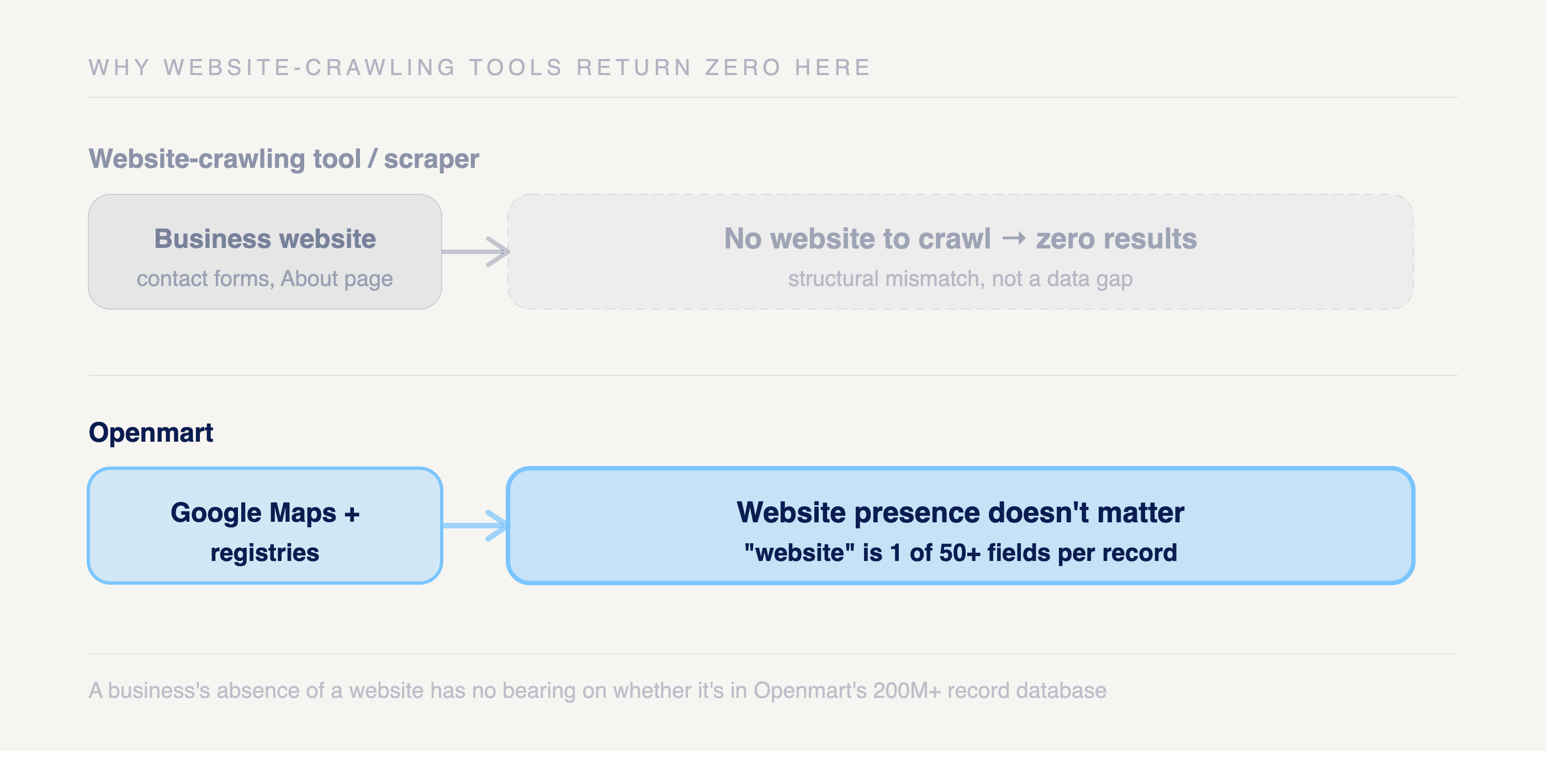
Most business-data tools, including scrapers and enrichment platforms, start from a company's website and extract data from it — contact forms, About pages, staff directories, review widgets. That approach works fine for businesses that have a site. It returns zero results for the ones that don't, which is precisely the segment a web design agency, local SEO seller, or marketing agency is trying to reach.
Openmart's data comes from Google Maps listings, business registries, and licensing records, not from parsing website content. A business with no website and a business with a five-page site show up in the same database, because neither one's presence or absence of a website changes whether Google Maps has a listing for it or whether it's registered with the state.
Openmart's data enrichment treats "website" as a single data field among 50+ per business record, alongside owner email, direct phone, employee count, and revenue estimate — and even validates whether an existing website is active and reachable. A blank field is just as usable a filter as a populated one.
The National Restaurant Association's 2024 Technology Landscape Report and BrightLocal's Local Consumer Review Survey both point to the same shift: local discovery now happens primarily through Google Business Profile and third-party platforms, not standalone websites, which is exactly the gap that leaves no-website businesses invisible to website-dependent tools while still fully visible on Maps and in registries.
Which categories skew heaviest toward no website

Not every industry has the same gap. Restaurants sit around 31% with no website, and the pattern holds across other categories where the business runs on foot traffic, referrals, or delivery-app visibility rather than search:
- Independent restaurants and food service — often listed via delivery apps or a Google Business Profile only, with no dedicated site behind it. This is the single largest sub-segment of the no-website gap. For a deeper breakdown specific to this category, see how to find restaurants with no website.
- Trade services (landscaping, cleaning, small contractors) — word-of-mouth and repeat customers drive the business, so a website is often seen as unnecessary overhead.
- Small independent retail — especially single-location shops relying on foot traffic and local reputation over online discovery.
Categories like law firms, medical practices, and financial services skew the opposite direction — a website is closer to a baseline expectation there, so the no-website opportunity is thinner and the prospecting angle doesn't apply as cleanly.
Who actually needs this list

Web design and local SEO agencies pitching sites to businesses that don't have one yet — the entire prospect list only makes sense if it's businesses without an existing site. A no-website business is a qualified lead by definition, not just a filter.
Marketing agencies targeting businesses with no digital footprint at all, where the opportunity is building the footprint from scratch — website, local SEO, Google Business Profile optimization — rather than improving an existing setup.
Software vendors selling booking, POS, reservation, or scheduling tools to businesses running on paper and phone calls. No website is frequently a signal of no software stack at all, which makes it a useful proxy filter even outside of web design specifically.
When this isn't the right approach
This works best as a targeted segment, not a default strategy. Teams whose ICP is mid-market or enterprise accounts should stick with tech-stack and firmographic signals instead, since those companies almost always have some web presence to index. And any list built this way still needs a phone-first outreach plan rather than an email-only sequence, since no-website businesses convert better through direct calls than cold email.
How to build a list of no-website businesses
Filter by category and location first, then check for a blank website field. Openmart's local business database returns a website field, populated or blank, alongside every business record, so a list can be filtered down to exactly the businesses with no site — no manual checking required.
Start with the categories where the gap is widest. Restaurants, independent retail, and trade services return a meaningfully higher share of no-website records than categories like law firms or medical practices, so targeting those first means less filtering to reach a usable list. Browse the full category directory to scope a search to the right vertical before pulling records.
Pull the owner's contact directly, not a form on a site that doesn't exist. Openmart's owner finder attaches verified email and direct phone to the business record itself, which matters specifically here — there's no contact form to fall back on when there's no website to host one.
Enrich beyond the basics if the pitch needs more context. Openmart's enrichment can add review counts, employee count, and revenue estimates to the same record, useful for qualifying which no-website businesses are actually worth prioritizing versus which are too small to be a fit.
Sequence the outreach with the missing website as the actual pitch. Openmart's email sequencing launches outreach directly from the same platform, framed around the fact that the business currently has no online presence — a specific, provable reason to reach out rather than a generic cold pitch.
Frequently asked questions
How do I find local businesses that don't have a website? Use a business database sourced from Google Maps listings and registries rather than a tool that crawls websites. Filter by category and location, then check the website field on each record — Openmart returns this whether or not a business has a site.
What percentage of small businesses don't have a website? Industry estimates range from 27% to 36% of US small businesses operating without a dedicated website, with the share running higher in specific categories — around 31% for restaurants.
Which industries have the most businesses without websites? Restaurants, independent retail, and trade services (landscaping, cleaning, small contractors) skew heaviest toward no-website operators. Categories like law firms and medical practices skew the opposite way, where a website is closer to standard.
Why do web scrapers miss businesses with no website? Scrapers extract data from web pages, so a business with no site produces nothing to scrape. A database sourced from Maps listings and public registries doesn't have this limitation, since it doesn't depend on a website existing.
Who typically needs a list of businesses without a website? Web design agencies, local SEO sellers, and software vendors pitching tools to businesses running without a digital presence. The lack of a website is often the entire reason the business is a qualified prospect.
Can I find the owner's contact info for a business with no website? Yes. Openmart attaches verified owner email and direct phone to each business record from Maps and registry data, independent of whether the business has a website to pull a contact form from.
Can I add more than just contact info to a no-website business record? Yes. Openmart's enrichment adds 50+ data fields including revenue estimate, employee count, and review counts, useful for qualifying which no-website prospects are worth prioritizing.
Related articles


Start reaching local businesses today
No credit card required
50M+ local business databases


.png)
