.svg)
What is tech sales? Roles, career paths, and how it differs from other B2B sales
TL;DR
Tech sales means selling software, SaaS, hardware, or technical services to business buyers. Three things separate it from other B2B verticals.
- A technical buyer. Engineers, IT admins, and security stakeholders evaluate the product on its merits, so reps need real product depth, not just relationship skills.
- Faster deal velocity. Inbound and product-led signups feed pipeline, and cycles move quicker than industrial or professional-services sales.
- The solutions engineer. A dedicated technical pre-sales role handles validation, demos, and proofs of concept that other verticals never staff for.
This guide focuses only on what makes tech sales distinct. For the general B2B sales process, stages, and standard role breakdown, read What is B2B sales?.
What tech sales means as a category
Tech sales means selling software, SaaS platforms, hardware, or technical services to other businesses. What separates it from other B2B verticals is not the product label. It is the complexity of what you sell and who decides to buy it. An industrial rep sells machinery to a plant manager, and a financial services rep sells advisory to a CFO. A tech rep sells a product that changes how a company's systems, data, and security work, and that pulls a different kind of buyer into the room.
That buyer is technical. In most tech deals, the person writing the check is not the person who decides whether the product survives evaluation. Engineers stress-test the integration, IT reviews how the tool fits the existing stack, and a security team asks how data is stored and who can access it. These stakeholders do not respond to relationship-building or a polished pitch deck. They ask specific questions and expect specific answers, which raises the floor on what a rep needs to understand.
Product complexity changes what the job demands day to day. A professional-services sale often turns on trust, reputation, and referrals built over years. A tech sale turns on whether the rep can explain how the product solves a problem the buyer has already scoped in technical terms. A rep who cannot speak to an API, a data model, or a deployment path loses credibility with the people who influence the decision most.
The familiar backbone of roles still applies. Sales development reps (SDRs) generate pipeline, account executives (AEs) close deals, and customer success managers (CSMs) keep accounts after the sale. Those roles work much the same way across B2B, and the B2B sales guide covers the full process, its stages, and each of these positions in depth. Rather than repeat that here, this piece focuses on what tech sales adds on top. The clearest addition is a role that industrial and professional-services teams rarely staff at all, and it exists precisely because the technical buyer demands it.
The solutions engineer: tech sales' signature role
A solutions engineer proves that the product does what the account executive claims it does. When a technical buyer asks whether the software handles their data volume, integrates with their existing stack, or passes their security review, the AE cannot answer credibly on their own. The solutions engineer, sometimes called a sales engineer or pre-sales engineer, exists to answer those questions with authority a buyer will trust.
The role owns technical validation across the deal. Solutions engineers run the deeper product demos, scope and manage proof-of-concept trials, and answer the objections that come from IT, security, and engineering teams. When a prospect asks about SOC 2 compliance, API rate limits, or how the product behaves under their specific configuration, the solutions engineer fields it. They translate a buyer's technical requirements into a demonstration that the product can meet them, and they translate the product's limits back into honest terms the buyer can plan around.
The handoff with the AE runs in both directions. The AE owns commercial ownership of the deal, meaning pricing, timeline, and the relationship with the economic buyer. Once a deal reaches technical evaluation, the AE pulls in the solutions engineer to run the demo or the trial, then takes the deal back to close once the technical stakeholders sign off. In a strong pairing, the AE knows when to step back and let the solutions engineer earn the technical buyer's confidence.

Technical pre-sales support exists in tech sales because the product is complex enough that a non-technical rep cannot validate it. Selling a piece of industrial equipment or a professional services engagement rarely requires someone to reconfigure a live environment or defend an architecture decision in front of a customer's engineers. Software and technical products do. A database platform, a security tool, or an infrastructure service gets evaluated by people who will run it, and those people test claims rather than accept them.
Without a solutions engineer, technical deals stall in evaluation. The AE fields questions they cannot answer, the buyer's technical team loses confidence, and the proof-of-concept either drags on or dies quietly. Deals that need a working trial to close simply do not close when no one on the sales side can make the trial succeed.
The solutions engineer is the clearest structural proof that tech sales differs from other B2B verticals. Product complexity does not just change what you sell. It forces a dedicated technical role into the sales motion itself, splitting the work between the person who owns the commercial relationship and the person who validates the technology. The general B2B sales roles do not include this split, because most verticals never need it.
Roles at a glance
The table below maps how a tech sales team splits work, with the solutions engineer sitting at the technical center of every deal.
| Role | What they own | Who they hand off to |
|---|---|---|
| SDR | Prospecting, qualifying inbound and outbound leads, booking first meetings | Account executive |
| AE | Running the deal, discovery, pricing, closing the contract | Solutions engineer for technical validation, CSM after close |
| Solutions engineer (standout role) | Technical validation, demos, proofs of concept, answering security and IT objections | Back to the AE to close, then to the CSM for handoff |
| CSM | Onboarding, adoption, renewals, expansion after the sale | Back to the AE when expansion becomes a new deal |
How tech sales differs from other B2B sales
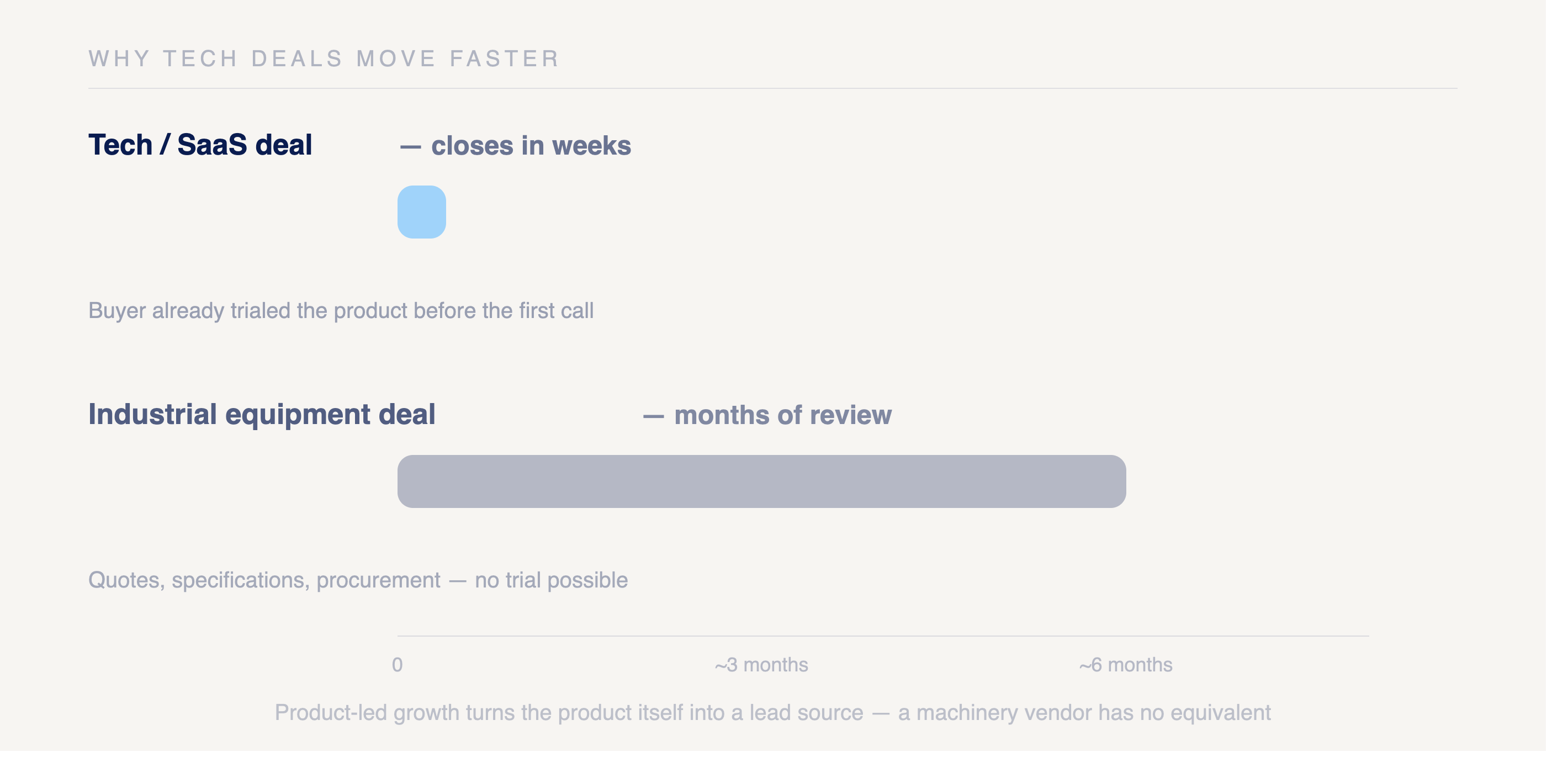
Tech sales pipeline arrives faster and from more directions than pipeline in industrial or professional-services sales, and the reason is the product itself. Software can be trialed, demoed, or spun up in a free account within minutes, so buyers often start evaluating before a rep ever calls. Product-led growth turns the product into a lead source, and inbound signups feed the pipeline alongside outbound. A machinery vendor or a consulting firm has no equivalent. Their buyers cannot test the offering without a meeting, a site visit, or a scoped engagement, which slows every cycle.
That difference in pipeline source changes deal velocity. A SaaS deal for a mid-market tool can close in weeks because the buyer has already seen the product work. An industrial equipment sale runs on relationships and referrals built over years, and the sales cycle stretches across months of quotes, specifications, and procurement review. Faster cycles mean tech reps run more deals at once, which raises the value of anything that keeps the pipeline full and accurately targeted.
The technical buyer raises the bar on what a rep needs to know. In professional services, trust and reputation often carry the deal, and a warm introduction can matter more than product specifics. A tech buyer expects the rep to speak to integrations, security posture, and how the product behaves under real workloads. A rep who cannot answer those questions loses credibility fast and usually loses the deal to a competitor whose team can.
Product depth and speed together explain why tech sales leans harder on software and data than other verticals. When a rep works dozens of opportunities against a technical buyer, the quality of the account list and the accuracy of contact data determine how much of that effort reaches the right person. Relationship-driven verticals can lean on a rolodex and referrals to fill the gap. Tech teams cannot, so they invest in tooling that surfaces the right accounts and verified contacts at volume. For a fuller look at the shared B2B foundation underneath all of this, see the B2B sales guide.
Tech sales compensation: base, variable, and OTE by role
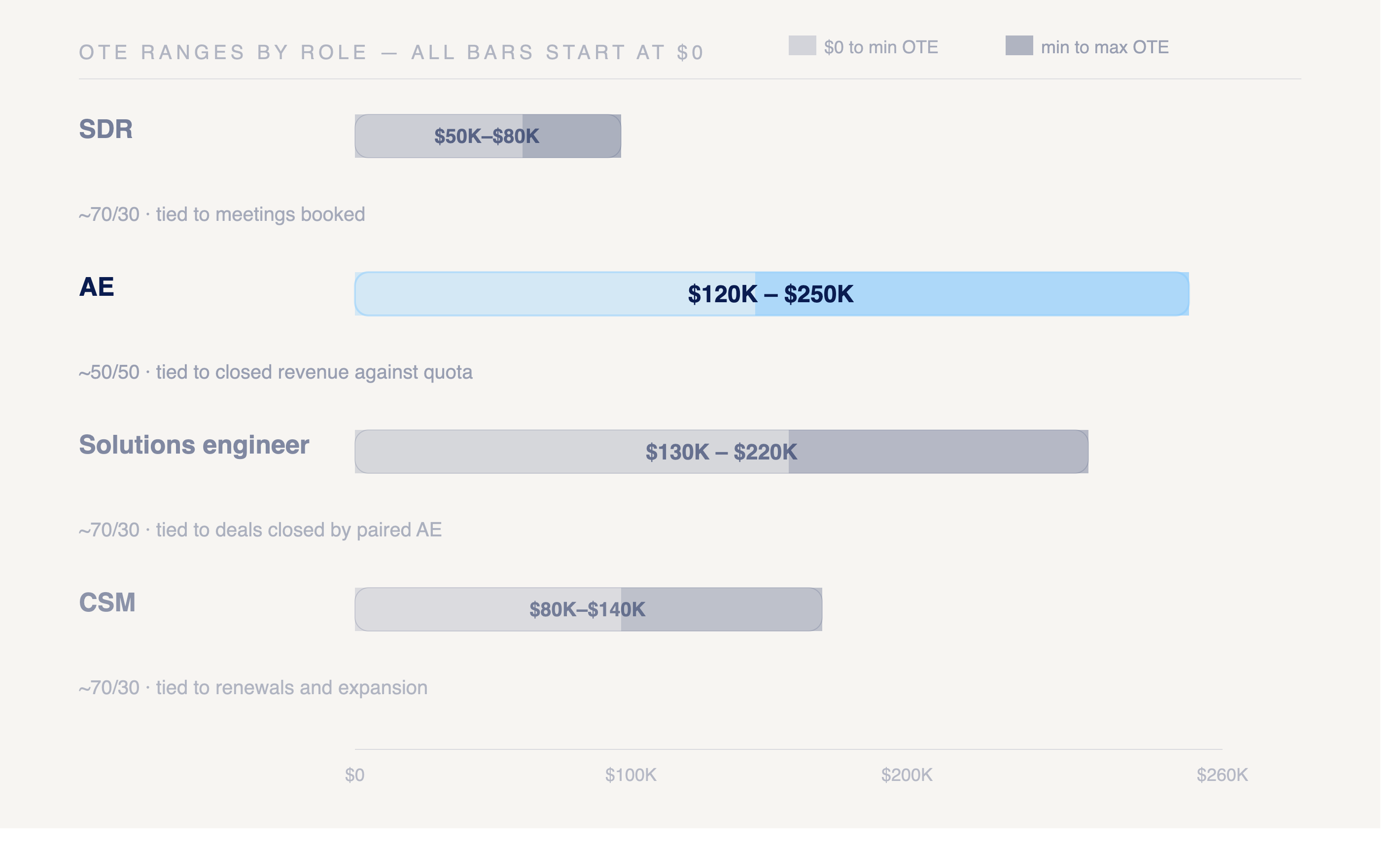
Tech sales pay runs on a base salary plus a variable component, and the split tells you how much of a role depends on hitting a number. On-target earnings, or OTE, describes what a rep makes when they close exactly their quota. A closing role like an account executive carries a roughly 50/50 split, so half the pay only arrives if deals land. Support roles that don't own a quota sit closer to 70/30, with more of the money guaranteed.
The table below lines up typical OTE ranges and base/variable splits by role.
| Role | Typical OTE | Base/variable split | Variable tied to |
|---|---|---|---|
| SDR | $50,000-$80,000 | ~70/30 | Meetings booked, pipeline generated |
| AE | $120,000-$250,000 | ~50/50 | Closed revenue against quota |
| Solutions engineer | $130,000-$220,000 | ~70/30 | Deals closed by their paired AE |
| CSM | $80,000-$140,000 | ~70/30 | Renewals and expansion revenue |
Individual contributor pay
Individual contributor pay scales with the size of the deals a role touches and how consistently reps clear quota. Sales development reps, who book meetings rather than close, sit at the bottom of the band, weighted heavily toward base. Account executives carry the widest range because their variable pay tracks the revenue they book directly. Reps selling six-figure enterprise contracts land at the top of that band, and reps in high-volume transactional sales sit lower.
Solutions engineers earn close to account executives but with a larger guaranteed base and a smaller variable slice. Their commission usually rides on the same deals their paired account executive closes, so they share in the upside without carrying full quota risk. Customer success managers land in a similar total range to senior SDRs or junior account executives, with variable pay tied to renewals and expansion rather than new logos.
Overperformance is where the model rewards the strongest reps. Most plans pay accelerators once a rep clears 100 percent of quota, so each dollar booked past target earns a higher commission rate. A rep at 150 percent of quota can double their variable pay, which is why top account executives at fast-growing companies out-earn their managers.
Treat every range here as a starting reference, not a promise. A seed-stage startup, a public scaleup, and a legacy enterprise pay the same title very differently, and a rep in San Francisco or New York commands more than one in a lower-cost market. Company stage, region, and the product's price point move these numbers more than the job title does.
The tech sales tool stack
Tech sales teams run on three tool categories, and each one solves a different bottleneck in getting from a target account to a closed deal. A CRM tracks every open opportunity, its stage, and its next step, so a manager can forecast the quarter and a rep never loses a deal to a missed follow-up. A sales engagement platform sequences the actual outreach, firing emails and call reminders on a set cadence so a rep can work hundreds of prospects without dropping any of them. Both matter, but neither creates pipeline on its own.
Prospect and company data tools decide whether the first two tools have anything worth processing. A CRM full of stale contacts and a cadence aimed at the wrong accounts produce activity, not pipeline. The binding constraint in tech sales is rarely how fast a rep can send emails. It is whether those emails reach a real decision-maker at a company that fits the ideal customer profile.
Contact accuracy determines pipeline quality more directly than any other input in the stack. A bounced email or a wrong-number dial costs a rep the same slot as a live conversation, so a database that is 30% out of date silently cuts effective outreach volume by a third. Verified ownership data matters even more when a team sells to small and local businesses, where the person who signs the contract is the owner rather than a titled buyer buried in an org chart. Generic contact databases index employees and stakeholders at large companies well, and they struggle to name the actual owner behind a smaller business.
Openmart builds its database around verified business data and the owner behind each business, including businesses that never show up in employee-directory tools because they have no website or corporate structure. For a tech sales team whose target list runs down-market, that ownership accuracy is the difference between a cadence that lands and one that echoes into empty inboxes. The CRM and the engagement platform then do their jobs on records that were worth loading in the first place.
FAQ
Is tech sales a good career? Tech sales offers high earning potential and clear advancement, with strong performers moving from SDR to AE to leadership in a few years. Demand stays steady because software and SaaS companies always need pipeline and revenue. The trade-off is quota pressure, so it rewards people who thrive on measurable targets.
Do you need a degree for tech sales? A degree is not required for most tech sales roles, especially entry-level SDR positions where companies hire on drive, communication, and coachability. Many reps break in through bootcamps, referrals, or adjacent roles like customer support. Solutions engineer roles are the exception, since they usually expect a technical background or hands-on product knowledge.
What is OTE in tech sales? OTE stands for on-target earnings, the total pay a rep earns when they hit 100% of quota. It combines a fixed base salary with variable commission, so an SDR might see an OTE around $70K to $90K while a senior AE can reach $200K or more. Actual earnings rise above OTE when a rep exceeds quota and fall below it when they miss.
Is tech sales stressful? Tech sales carries real stress because pay depends on hitting monthly and quarterly quotas that reset constantly. The pressure eases at companies with strong inbound pipeline and realistic targets. Reps who build repeatable process and steady pipeline volume feel far less of the month-end scramble.
Related articles



Start reaching local businesses today
No credit card required
50M+ local business databases


.png)
