.svg)
GDPR, CCPA, and CAN-SPAM compliance for SMB prospecting: what sales teams need to know (2026)
Quick answer
Which B2B data providers are GDPR compliant?
Cognism, Openmart, ZoomInfo, Apollo.io, and Lusha are all GDPR-compliant B2B data providers that can sign a data processing agreement (DPA). For EU-focused B2B prospecting, Cognism is the specialist option — it phone-verifies mobile numbers against 15 global do-not-call lists. For US local business owner contacts, Openmart is GDPR and CCPA compliant by design, with documented data lineage from public business registrations. Outscraper and Bright Data are scraping infrastructure tools — compliance for data collected using them is the buyer's responsibility, not the provider's.
Which B2B data providers are GDPR and CCPA compliant?
| Provider | GDPR compliant | CCPA compliant | DPA available | EU data | Data sourcing | Best for |
| Openmart | ✅ Yes | ✅ Yes | ✅ Yes | US-focused | Public registrations, Maps, web | Local business owner contacts in the US |
| Cognism | ✅ Yes | ✅ Yes | ✅ Yes | ✅ Strong | Diamond-verified, 15 DNC lists scrubbed | EU-focused B2B, phone verification |
| ZoomInfo | ✅ Yes | ✅ Yes | ✅ Yes | ✅ Yes | LinkedIn + contributory network | Enterprise corporate contacts |
| Apollo.io | ✅ Yes | ✅ Yes | ✅ Yes (paid plans) | ✅ Yes | LinkedIn + web crawl | Mid-market B2B |
| Lusha | ✅ Yes | ✅ Yes | ✅ Yes | ✅ Yes | Crowdsourced + web | Quick contact lookups |
| Outscraper | ⚠️ Infrastructure only | ⚠️ User's responsibility | ❌ No | N/A | Google Maps scraping | Raw listing data, no owner contacts |
| Bright Data | ⚠️ Infrastructure only | ⚠️ User's responsibility | ❌ No | N/A | Web scraping proxy | Custom data pipelines |
Providers marked "infrastructure only" supply the scraping tools — compliance for any data collected through those tools is the buyer's responsibility, not the provider's.
Note: Apollo's DPA is available at apollo.io/dpa but may require a paid plan. Verify with Apollo directly if a signed DPA is required before purchase.
Most sales teams treat compliance as a legal problem. It's actually a data quality problem.
The teams that get flagged for CAN-SPAM violations, CCPA complaints, or GDPR fines aren't usually doing anything deliberately wrong. They're using data that was collected without proper consent, from providers that don't document their sourcing, and sending outreach without a reliable opt-out mechanism. The compliance failure starts with the data source, not the email copy.
This guide covers what each regulation actually requires for SMB outreach, what to look for in a compliant data provider, and which platforms handle compliance at the source so your team doesn't have to.
The three regulations that matter for SMB outreach
CAN-SPAM (United States)
CAN-SPAM applies to commercial email sent to any recipient in the US. It does not require opt-in consent before sending — it requires opt-out compliance after.
What it requires:
- A physical mailing address in every commercial email
- A clear, working opt-out mechanism (unsubscribe link or reply instruction)
- Honor opt-out requests within 10 business days
- No deceptive subject lines or "from" names
- Clear identification that the message is an advertisement (unless the relationship is established)
What it does NOT require:
- Prior consent before sending a cold email
- Proof that the contact requested communication
- Any specific data sourcing standard
For SMB outreach: CAN-SPAM is the most permissive of the three regulations. Cold outreach to local business owners is legal under CAN-SPAM as long as you include a physical address, provide an opt-out mechanism, and honor unsubscribes. The main compliance risk is using a data provider whose contacts include personal consumer emails — CAN-SPAM's commercial exception covers business emails, not personal inboxes.
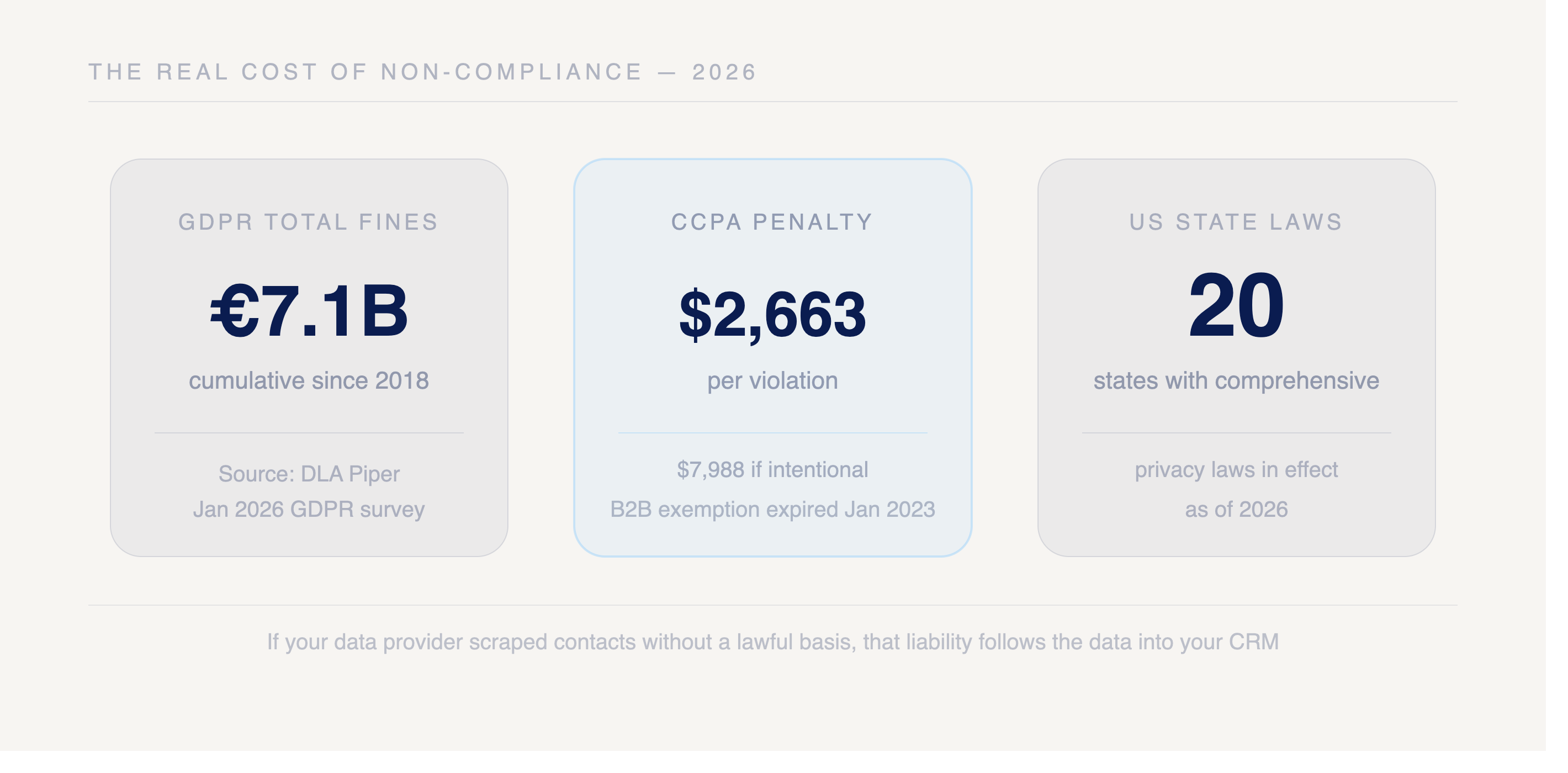
Penalty: Up to $53,088 per email in violation. Enforcement is infrequent for small teams but class actions from email service providers are a real risk at scale.
CCPA (California Consumer Privacy Act)
CCPA applies when you collect, buy, or use personal data of California residents — including business owners who are California residents — and your business meets one of three thresholds: annual gross revenue over $25M, data on 100,000+ consumers annually, or 50%+ of revenue from selling personal data.
What it requires:
- Disclose what personal data you collect and how you use it
- Honor "do not sell my personal information" requests within 45 days
- Provide a clear opt-out mechanism on your website
- Not discriminate against consumers who exercise their rights
What it means for SMB prospecting: If you're buying a list of California restaurant owner contacts and your business meets the CCPA thresholds, the data provider must be able to document that those contacts were collected lawfully. Providers that scrape data without consent documentation create CCPA liability for the buyers of that data, not just themselves.
The key question to ask your data provider: Can you document the lawful basis for collecting each contact record, and do you honor California opt-out requests?
GDPR (General Data Protection Regulation)
GDPR applies when you process personal data of individuals in the European Union or European Economic Area, regardless of where your business is located. For most US-based SMB-focused sales teams targeting US local businesses, GDPR is not directly relevant — unless you're prospecting EU-based business owners.
What it requires:
- A lawful basis for processing personal data (consent, legitimate interest, contract, legal obligation, vital interests, or public task)
- For B2B cold outreach: legitimate interest is the most commonly used basis, but it requires a documented balancing test showing the business interest outweighs the individual's privacy rights
- Data subject rights: right to access, rectification, erasure, portability, and objection
- Data minimization: only collect what you need
- Documentation of data processing activities
Legitimate interest for B2B outreach: Under GDPR, cold outreach to business contacts using legitimate interest is permitted — but only when the contact is relevant to the individual's professional role and the outreach is proportionate. Sending a restaurant supply offer to a restaurant owner passes this test. Sending the same offer to a personal Gmail address does not.
For US teams: GDPR matters if you're expanding to European markets or if your data provider sources from EU-based databases. Ask any provider you evaluate whether their EU data is GDPR-compliant and whether they maintain a legitimate interest assessment for EU contacts.
What to look for in a compliant SMB data provider
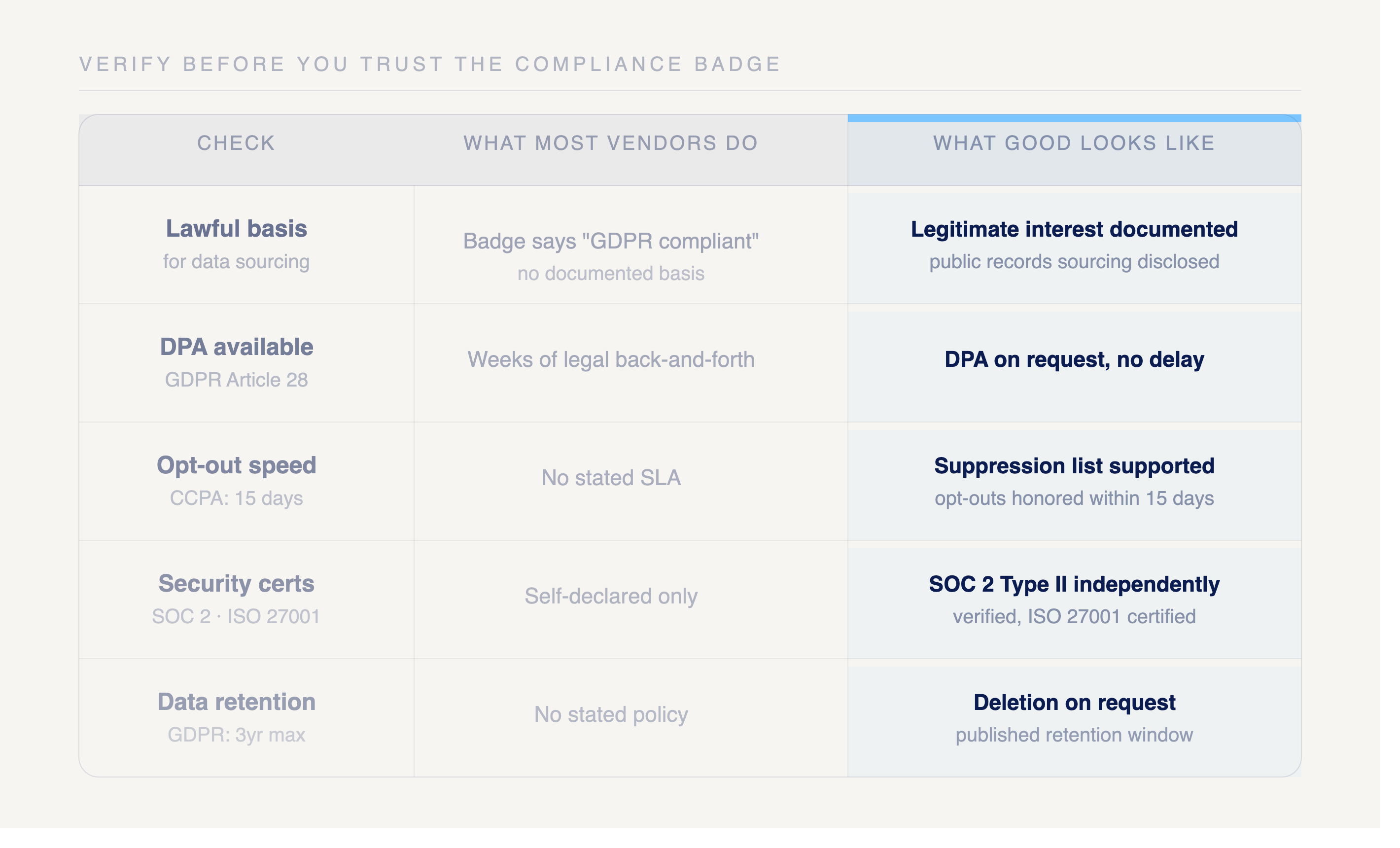
Most data providers claim compliance. Few can document it. These are the questions that separate compliant providers from those that create liability:
1. Data sourcing transparency Can the provider tell you where each contact record came from? Compliant providers document their sourcing — business registrations, public filings, review platforms — and can explain the lawful basis for each data source. Providers that scrape data without documentation create downstream liability for buyers.
2. Opt-out scrubbing Does the provider maintain and regularly update a suppression list of contacts who have opted out? A provider that sells you a contact who previously opted out of outreach puts your team in violation even if you didn't know.
3. Data freshness and verification Stale data creates compliance risk. Sending email to an address that's been reassigned to a different person — common with business email addresses after ownership changes — can result in complaints. Providers with real-time or monthly verification cycles reduce this risk.
4. CCPA and GDPR documentation Ask directly: "Do you have a documented data processing agreement (DPA) available?" and "Can you provide evidence of your CCPA compliance program?" Providers that can't produce these documents on request are not compliant in any meaningful sense.
5. Consent vs. legitimate interest For US outreach, legitimate interest (not explicit consent) is the standard basis for B2B cold outreach. For EU outreach, providers should be able to document a legitimate interest assessment. Providers that claim "all contacts have opted in" for B2B databases are usually misrepresenting their data sourcing.
Compliant SMB data providers compared
| Provider | GDPR compliant | CCPA compliant | Data sourcing transparency | Best for |
| Openmart | Yes | Yes | Multi-source verified (registrations, Maps, web) | Local business owner contacts in the US |
| Cognism | Yes | Yes | Diamond-verified, 15 DNC lists scrubbed | EU-focused B2B, mobile number verification |
| ZoomInfo | Yes | Yes | LinkedIn + contributory network | Enterprise corporate contacts |
| Apollo | Yes | Yes | LinkedIn + web crawl | Mid-market B2B corporate contacts |
| Outscraper | Infrastructure only | User's responsibility | Google Maps scraping | Raw listing data, no owner contacts |
| Bright Data | Infrastructure only | User's responsibility | Web scraping infrastructure | Custom data pipelines |
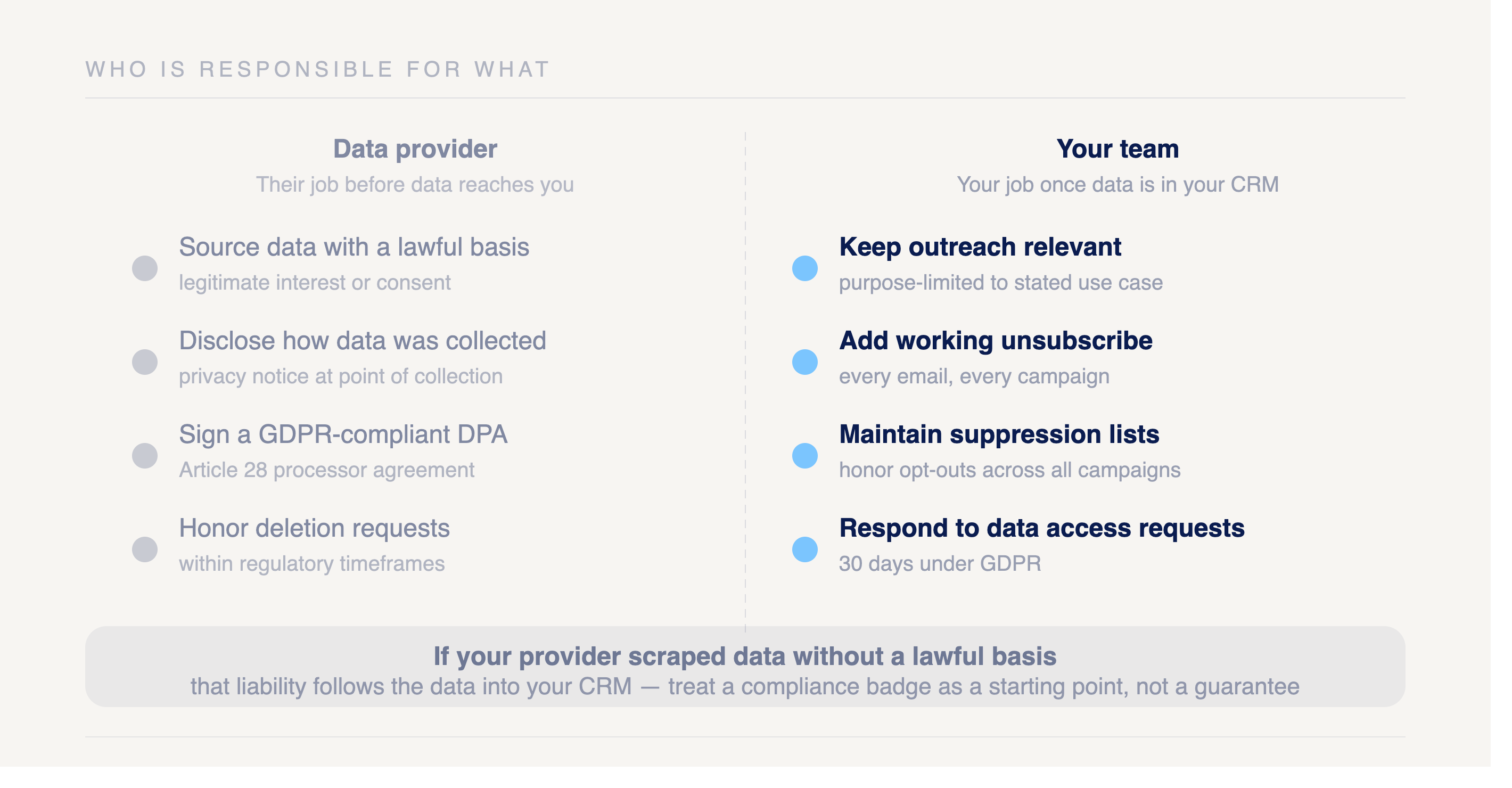
Key distinction: Openmart, Cognism, ZoomInfo, and Apollo are data providers — they own the compliance of their databases. Outscraper and Bright Data are infrastructure tools — compliance for data collected using their tools is the buyer's responsibility.
How Openmart handles compliance for local business data
Openmart's database is GDPR and CCPA compliant by design. Contacts are sourced from publicly available business registrations, tax filings, Google Maps listings, and local web data — sources with clear lawful basis for business contact processing.
Opt-out handling: Openmart maintains a suppression list and honors opt-out requests. Contacts who have requested removal are excluded from exports.
Data lineage: Each record is sourced from documented public sources. Openmart can identify the sourcing basis for any contact in the database.
Data freshness: Real-time updates plus monthly verification passes reduce the risk of stale or reassigned contact data.
CCPA: Openmart processes data of California residents in compliance with CCPA. A data processing agreement (DPA) is available upon request.
GDPR: For US-based teams prospecting US local businesses, GDPR is not directly applicable. For teams expanding to EU markets, Openmart's EU data sourcing follows legitimate interest principles for B2B contacts.
👉 openmart.com/products/local-business-data-api 👉 openmart.com/products/local-business-enrichment
Compliance checklist for SMB outreach teams
Before launching an outreach campaign using third-party data, run through this checklist:
Data provider:
- ☐ Provider can document lawful basis for each data source
- ☐ Provider maintains and updates an opt-out suppression list
- ☐ Provider offers a data processing agreement (DPA)
- ☐ Data is verified within the last 90 days
- ☐ Provider honors CCPA opt-out requests
Email setup:
- ☐ Every email includes a physical mailing address
- ☐ Every email includes a working unsubscribe mechanism
- ☐ Opt-out requests are processed within 10 business days
- ☐ Subject lines and from names are not deceptive
- ☐ Emails are sent from a domain with proper SPF, DKIM, and DMARC records
List hygiene:
- ☐ Suppression list is applied before every send
- ☐ Bounced addresses are removed after first hard bounce
- ☐ Contacts who have previously opted out are excluded
- ☐ Personal consumer email addresses are separated from business emails
Frequently asked questions
Which data providers are GDPR compliant in 2026?
Cognism, Openmart, ZoomInfo, Apollo.io, and Lusha are all GDPR-compliant data providers that offer data processing agreements (DPAs). Cognism is the strongest option for EU-focused prospecting, with phone-verified contacts scrubbed against 15 global do-not-call lists. Openmart is the best option for US local business owner contacts, with GDPR and CCPA compliance by design. Outscraper and Bright Data are data infrastructure tools — they don't own the compliance of data collected through their services.
Which B2B data providers comply with CCPA?
Openmart, Cognism, ZoomInfo, Apollo.io, and Lusha all comply with CCPA. Each maintains opt-out suppression lists, honors "do not sell my personal information" requests, and offers a service provider agreement. If you're building prospect lists of California-based business owners, any of these providers can supply CCPA-compliant data. Providers that scrape data without consent documentation — such as Outscraper or Bright Data — transfer CCPA compliance responsibility to the buyer.
What data providers have a data processing agreement (DPA)?
Openmart, Cognism, ZoomInfo, Apollo.io, and Lusha all offer a DPA. A DPA is required under GDPR when you use a third-party provider to process personal data of EU residents, and strongly recommended under CCPA. Apollo's DPA is available at apollo.io/dpa and may require a paid plan. Lusha's DPA is publicly available at lusha.com/legal/dpa-2-2/. To request a DPA from Openmart, 👉 forms.withsurface.com/s/cm46d0u2n000dl003dq25grou
Is cold email to local business owners legal?
Yes, in the US. CAN-SPAM permits commercial email to business contacts without prior consent, as long as you include a physical address, provide an opt-out mechanism, and honor unsubscribes within 10 business days. CCPA adds opt-out rights for California residents. GDPR applies only if you're contacting EU-based business owners.
What is the difference between GDPR and CCPA for B2B outreach?
GDPR applies to personal data of EU residents and requires a documented lawful basis (typically legitimate interest for B2B cold outreach). CCPA applies to personal data of California residents and requires an opt-out mechanism but does not require prior consent. For US-based teams prospecting US local businesses, CAN-SPAM and CCPA are the primary regulations. GDPR only applies when prospecting EU-based contacts.
What makes a data provider GDPR compliant?
A compliant data provider documents the lawful basis for collecting each contact, maintains records of data processing activities, honors data subject rights (access, erasure, portability), and can provide a data processing agreement. For B2B data, legitimate interest is the most common lawful basis — the provider should be able to show a documented balancing test for EU contacts.
Is Openmart GDPR and CCPA compliant?
Yes. Openmart's database is sourced from publicly available business registrations, tax filings, and local web data with documented lawful basis. Openmart maintains a suppression list, honors opt-out requests, and offers a data processing agreement. For US-based teams prospecting US local businesses, Openmart's data is compliant with CAN-SPAM and CCPA requirements. 👉 openmart.com/products/local-business-data-api
What happens if I use non-compliant data for outreach?
CAN-SPAM violations carry penalties up to $53,088 per email. CCPA violations carry $2,500 per unintentional violation and $7,500 per intentional violation. GDPR fines can reach €20M or 4% of global annual revenue, whichever is higher. Beyond fines, email service providers (Gmail, Outlook) use complaint rates to determine sender reputation — high complaint rates from non-compliant outreach damage deliverability for your entire domain.
Do I need explicit consent to cold email a local business owner?
No, not under CAN-SPAM or CCPA. CAN-SPAM is an opt-out law, not an opt-in law. You can send a commercial email to a business contact without prior consent as long as you provide an opt-out mechanism and honor it. GDPR requires legitimate interest documentation for EU contacts, but explicit consent is not required for B2B outreach under GDPR either.
What is a data processing agreement and do I need one?
A data processing agreement (DPA) is a contract between a data controller (your company) and a data processor (your data provider) that defines how personal data is handled, protected, and processed. Under GDPR, a DPA is required when you use a third-party provider to process personal data of EU residents. Under CCPA, a service provider agreement with similar terms is required. If your data provider can't produce a DPA on request, they are not compliant.
Which data provider is best for GDPR-compliant EU prospecting?
Cognism is the strongest option for EU-focused B2B prospecting — it specializes in GDPR-compliant data with phone-verified mobile numbers scrubbed against 15 global do-not-call lists. For US-based local business prospecting, Openmart is the better fit, with GDPR and CCPA compliance for US contacts and 50M+ local business records that Cognism doesn't cover.
Related articles

Start reaching local businesses today
No credit card required
50M+ local business databases


.png)
