.svg)
Openmart pricing explained: How credits work for SMB lead generation
TLDR
Openmart charges credits for the contact data you pull, not for seats or subscriptions. You spend credits when you reveal an email, a phone number, or a full enriched profile, and you only pay when the data arrives. Phone numbers cost more credits than emails, by design, because verified phone retrieval takes more work to deliver. This page is for SMB sales teams and marketers deciding whether a credit model fits their prospecting volume. The higher phone cost reflects delivery effort, not a penalty.
How Openmart credits work
A credit is a unit of data retrieval. You spend it to pull one piece of verified contact information, and the amount you spend depends on what you ask for. Revealing a business email costs the least. Pulling a direct phone number costs more. A full enrichment, which bundles email, phone, and firmographic detail into a single record, costs the most.
- Decision-maker name/title [0 credits]
- Email reveal [3 credits]
- Phone reveal [8 credits]
- Full enrichment [8-20 credits]
Credits charge on successful delivery, not on attempts. If Openmart cannot find a verified phone number for a contact, you keep the credit. Tropic calls this the difference between cost-based and outcome-based credits, where "cost-based credits charge you every time you attempt an AI action, whether it succeeds or fails. Outcome-based credits charge you when the AI actually delivers value." Openmart runs on the outcome side of that line.
You control your spend by choosing what to retrieve. An email-first marketer never touches phone credits. A cold-caller spends more per contact but pays only for numbers that come back verified. Each action carries a fixed rate, so your monthly cost scales directly with the data you actually use.
What your lead budget actually buys: three workflow scenarios
Credit math gets abstract fast, so map it to the work you actually do. Each scenario below assumes a single action per lead and uses placeholder rates.
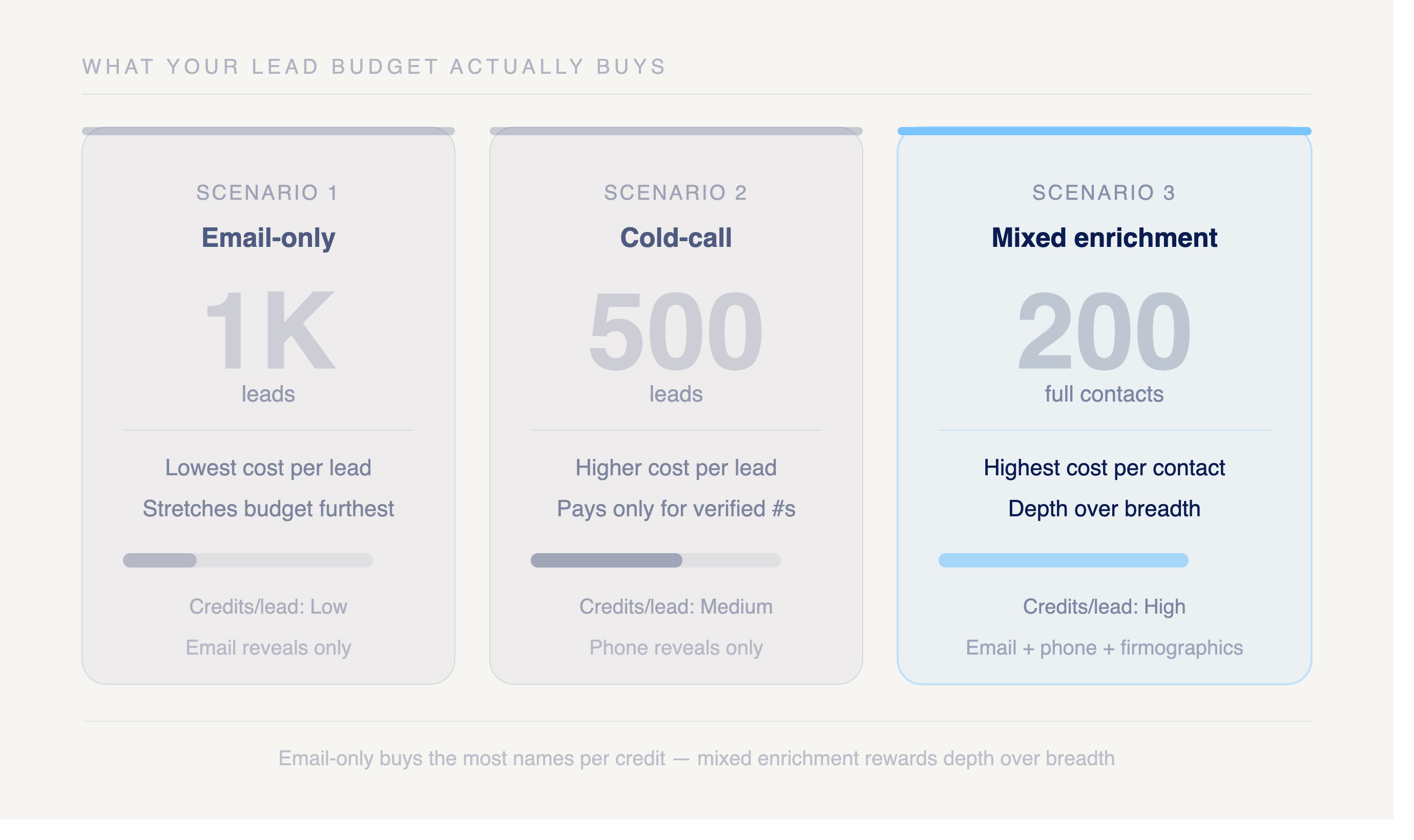
Swap in the live figures from your plan to get exact totals.
Scenario 1: email-only, 1,000 leads
You run inbound nurture or cold email at volume, and you need verified addresses without phone numbers. At 2 credits per email reveal, 1,000 leads costs 2,000 credits. Email reveals carry the lowest per-action rate, so this workflow stretches a credit balance further than any other. On the Starter plan, that runs about $42; on Scale, about $37.50.
Scenario 2: cold-call, 500 leads
You build call lists and need verified direct phone numbers to reach buyers fast. Phone reveals run 8 credits each, which is higher than email because the data takes more work to confirm. At 500 leads, you spend 4,000 credits, landing around $84 on Starter or $75 on Scale. Fewer leads cost more here than a larger email pull, and that tradeoff reflects the value of a connected call over an unopened inbox.
Scenario 3: mixed enrichment, 200 full contacts
You want the complete record on a smaller, high-intent list. Each full enrichment bundles email, phone, and firmographic data into one action at 8 to 20 credits. For 200 contacts, that totals 1,600 to 4,000 credits, running about $34 to $84 on Starter or $30 to $75 on Scale. The bundle saves credits against revealing email and phone separately, so full enrichment pays off when you need both fields on every name.
Read across the three scenarios and a pattern shows up. The email-only pull buys the most names per credit. The cold-call list buys the fewest, because phone data costs more to verify. The mixed pull sits between them and rewards depth over breadth.
You only spend credits when Openmart returns data. A failed lookup costs nothing, so these totals reflect successful deliveries, not attempts. That changes the math in your favor when you compare a flat per-seat tool that charges whether or not it finds the contact.
Openmart vs. broad-category alternatives
Most lead data tools fall into one of two camps, and Openmart sits between them on purpose. Enterprise B2B platforms sell deep coverage behind annual contracts and seat minimums. General contact databases sell volume cheaply but leave you guessing what each lookup costs.
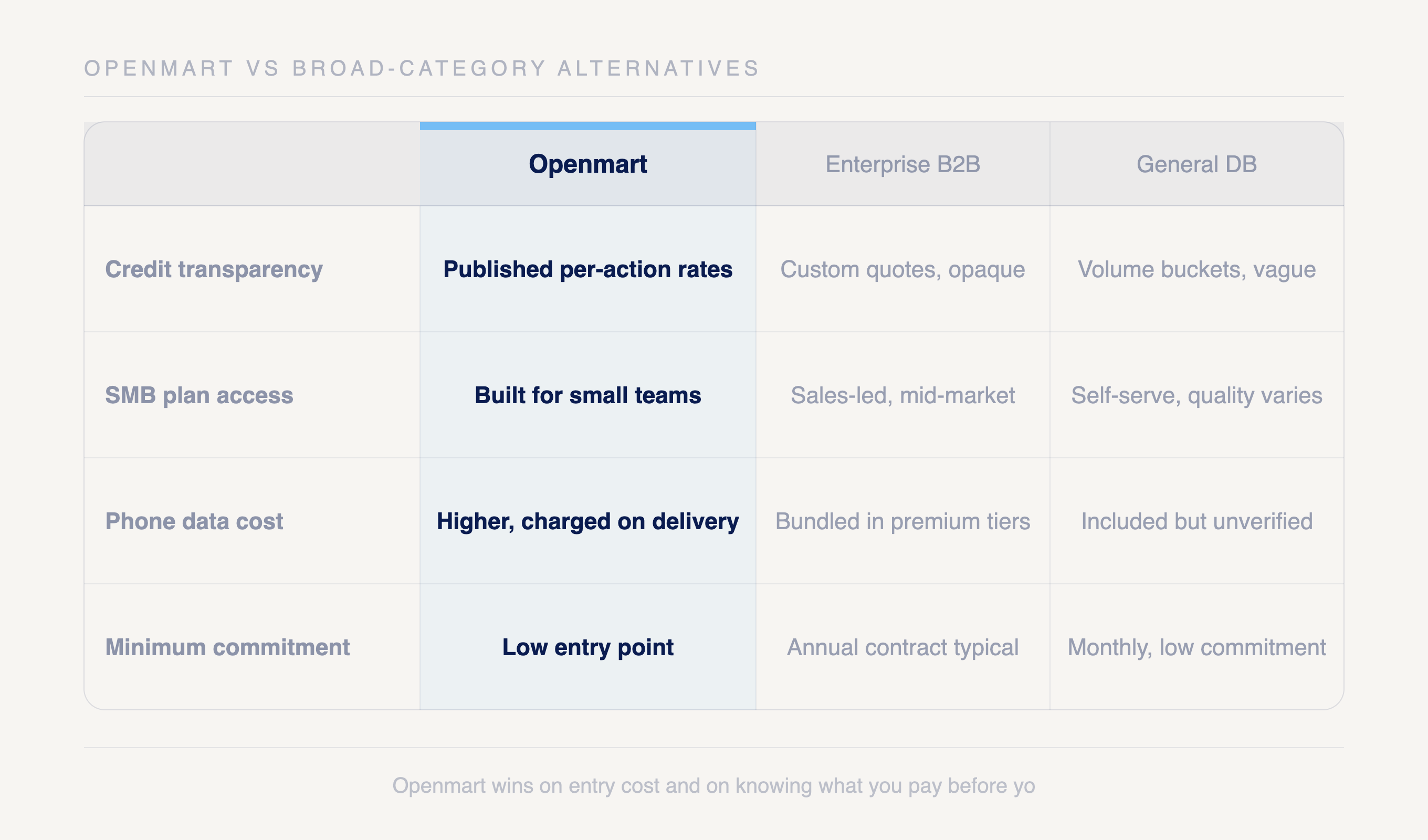
Openmart wins on entry cost and on knowing what you pay before you pay it. You can see the credit rate for an email reveal, a phone reveal, or a full enrichment, then run the math yourself. Enterprise platforms hide that rate inside a quote, and general databases bury it inside a volume tier that rarely tells you whether a phone number was verified.
The tradeoff is honest. You pay more per phone number than a bulk database charges, but you pay only when Openmart delivers a working contact.
Best for: matching buyer type to the credit model
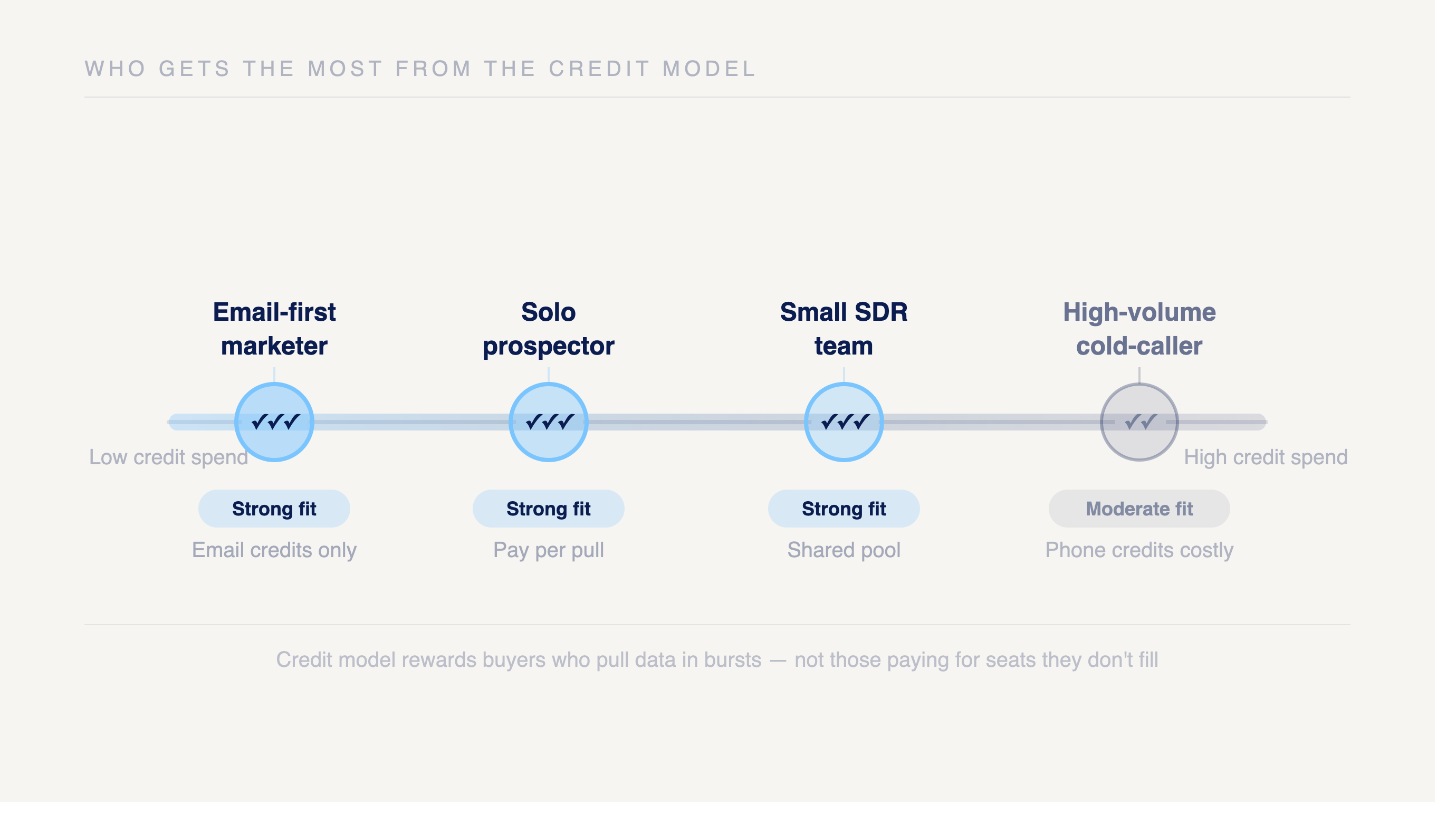
The credit model rewards buyers who pull data in bursts rather than paying for seats they don't fill. Four profiles get the most out of it.
Solo prospector
A one-person operation pays only for the contacts pulled. Buy a small credit pack, spend it on the 50 accounts that matter this month, and skip the per-seat fees that enterprise tools charge whether you log in or not. Fit is strong.
Small SDR team
Two to five reps sharing a credit pool can split a workload without provisioning a license for each person. You allocate credits to whoever is dialing or emailing that week. Fit is strong for teams that run uneven activity across reps.
Email-first marketer
Email reveals cost the fewest credits, so a marketer building outreach lists stretches a budget furthest here. You avoid paying phone-data premiums for contacts you'll never call. Fit is strong.
High-volume cold-caller
A caller burning through hundreds of phone numbers a week consumes credits fast because phone reveals carry the highest cost. The model still works if you accept that verified phone data is the expensive line item. Fit is moderate, and worth modeling against your monthly dial count before committing.
Why phone credits cost more (and why that's the point)
A phone number costs more credits than an email reveal because Openmart spends more to confirm it works. Pulling a verified direct-dial requires deeper sourcing and validation than matching a corporate email pattern. You pay for the harder work because the harder work is what gets you a connect.
Software buyers tend to read differential credit costs as a vendor passing its own infrastructure bill to the customer. That suspicion is fair when pricing is opaque. The honest test, drawn from Tropic's framework, is whether credits charge you for attempts or for outcomes. Cost-based systems bill every time the tool tries. Outcome-based systems bill only when value lands.
Openmart sits on the outcome side. A phone credit gets consumed when a valid, deliverable number reaches your screen, not when the system goes looking and comes back empty. Paying more for phone data reflects the higher value of a verified connect, not an arbitrary markup.
Frame it against the alternative. A cheaper credit that returns a dead number costs you the dial, the bad-data cleanup, and the wasted SDR minute. A phone credit priced for verified delivery moves your pipeline. The premium buys precision, and precision is what a cold-caller is actually paying for.
Frequently asked questions
Do unused credits roll over? Rollover terms depend on your plan, so check the current policy on the Openmart pricing page before you commit. Plan your monthly credit purchase around your typical lead volume rather than buying a buffer you might lose.
What counts as a failed enrichment? A failed enrichment is any retrieval where Openmart cannot return verified data for the contact type you requested. You are not charged credits for those attempts, which keeps your spend tied to data you can actually use.
Can teams share a credit pool? A shared pool lets your SDRs and marketers draw from the same balance instead of managing separate seat allocations. Confirm pooling terms on the pricing page, since availability varies by plan size.
Is there a free tier? Openmart offers entry-level access designed for SMB budgets rather than enterprise minimums. Review the current pricing page to see whether a free trial or starter allotment applies to your account.
Methodology and pricing assumptions
The credit values in the scenarios above are placeholders. Confirm current per-action rates at openmart.com/pricing before you build a budget. The scenario math scales linearly from those per-action rates, so a workflow at twice the lead volume costs roughly twice the credits. Treat the totals here as a structural guide to how credit consumption behaves, not as a quote.
Related articles


Start reaching local businesses today
No credit card required
50M+ local business databases


.png)
