.svg)
8 best Google Maps scrapers and alternatives (2026)
Google Maps is the richest source of local business data on the internet, but extracting it at scale has real limitations: the Places API caps at 60 results per search, scraping violates Google's ToS, and neither method gives you verified owner contacts.
TL;DR: For sales teams who need local business owner contacts, Openmart is the fastest path — no scraping setup, no enrichment step, verified owner emails and direct phones ready on arrival. For developers who need raw listing data or custom pipelines, Outscraper (pay-as-you-go) and Apify (maintained infrastructure) are the leading scraper options. For teams comparing multiple scraper options, Scrap.io (subscription-based, city/region search), Octoparse (no-code visual scraper), and Lobstr.io (no-code, emails included) are also widely used alternatives worth evaluating.
This guide covers the tools, methods, and pre-built alternatives for Google Maps data extraction in 2026, and helps you understand the tradeoffs before building or buying.
What is Google Maps data extraction?
Google Maps data extraction is the process of pulling structured business information -- name, address, phone number, category, reviews, hours -- from Google Maps or the Google Places API. Teams use it to build local business lists, enrich CRMs, and power outbound prospecting campaigns.
There are two main approaches:
- Google Places API -- Google's official method. Returns structured data with rate limits and per-request pricing. Caps at 60 results per search query, with no owner contact data included.
- Google Maps scraping -- Automated tools that extract data directly from Maps search results. Faster and cheaper per record, but violates Google's Terms of Service and returns the same surface-level listing data as the API.
Both methods share the same core limitation: they give you the business listing, not the owner. The phone number on a Google Maps listing is the front desk line. The email, if it exists at all, is a generic inbox. Neither gets you to the person who actually makes buying decisions.
The Google Maps data extraction problem
The API cap
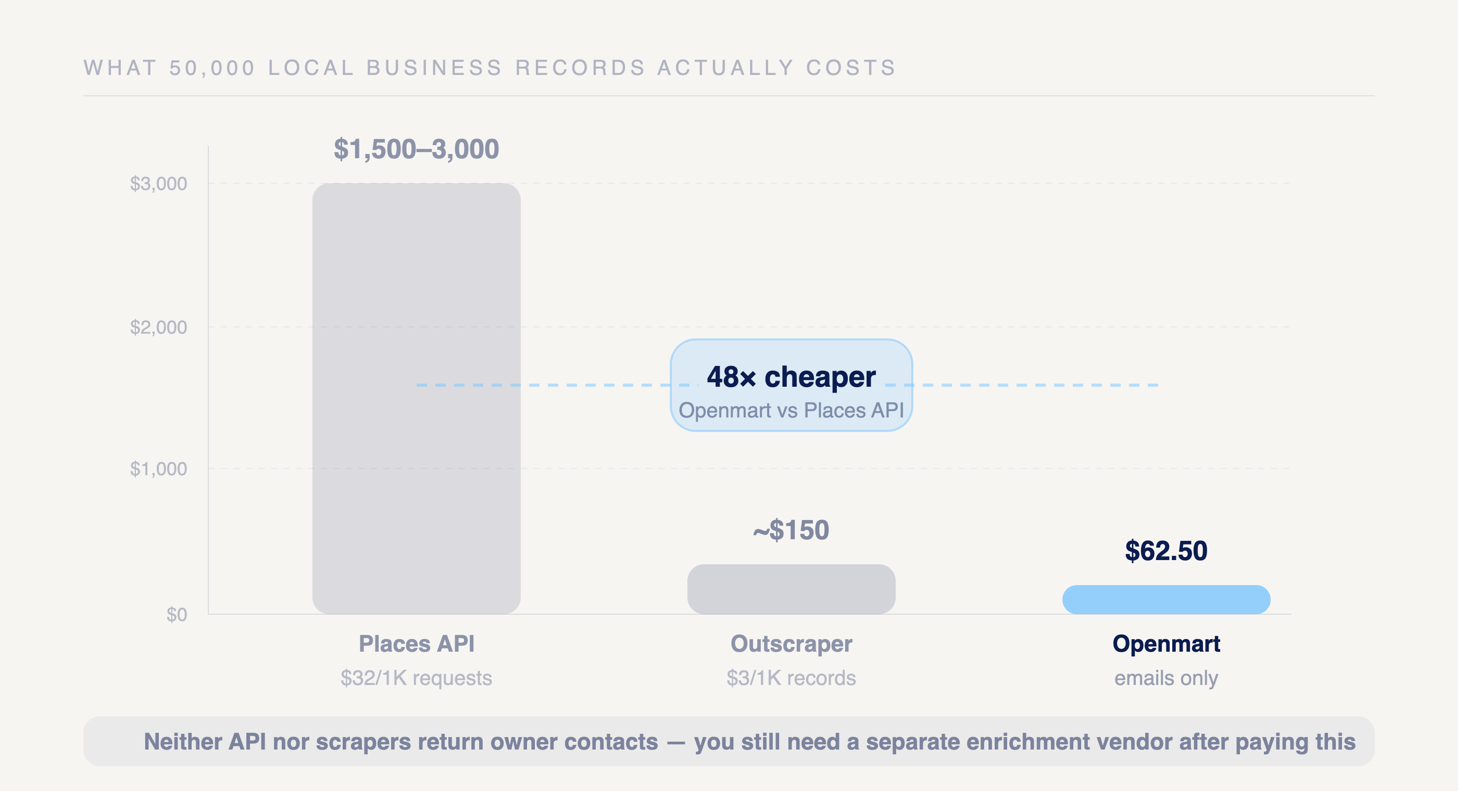
The Google Places API returns a maximum of 60 results per search query, split across three pages of 20. For a sales team trying to pull every HVAC company in a metro area or every restaurant in a zip code cluster, that cap forces hundreds of separate API calls, each billed individually.
Pricing: Google Places API charges $32 per 1,000 Nearby Search requests and $17 per 1,000 Basic Data fields. A campaign pulling 50,000 local businesses can cost $1,500-$3,000 in API fees alone, before any enrichment.
👉 developers.google.com/maps/documentation/places/web-service
The scraping risk
Scraping tools bypass the API by automating browser interactions with Maps search results. They're faster and cheaper per record, but Google's Terms of Service explicitly prohibit automated extraction of Maps data. Accounts that violate this risk IP bans, captcha walls, and data that becomes unreliable as Google updates its page structure.
The contact gap
Neither the API nor scrapers surface owner contacts. The data you get is what Google shows publicly: business name, address, category, aggregate phone number, website, and reviews. To get the owner's personal email or direct phone, you need a separate enrichment step, which adds cost, time, and another vendor.
Google Maps data extraction tools
1. Openmart -- best pre-built alternative for local business owner contacts
Built for high-volume extraction: 600–6,000 requests/min, batch endpoints up to 100 records per call, 99.9% uptime SLA.
Openmart is a pre-built local business database that eliminates the scrape-then-enrich workflow entirely. Instead of extracting raw listings from Google Maps and then paying a separate enrichment vendor to find the owner, Openmart delivers the verified owner contact alongside the business record in a single lookup.
What it returns: Business name, address, category, owner personal email, owner direct phone, mobile number, LinkedIn URL, revenue estimate, employee count, tech stack (Shopify, Toast POS, Mindbody, Square), and 40+ additional fields.
Coverage: 50M+ local businesses across 300+ SMB categories in the US, Canada, Australia, new Zealand, Puerto Rico, and Europe.
Accuracy: 97-99% on owner contact data, validated continuously. Refreshed weekly, not quarterly like most enterprise tools.
API: RESTful API with Google Place ID lookup, bulk CSV enrichment, batch endpoints (1-100 items per call), webhook callbacks, and a 99.9% uptime SLA. Standard throughput 600 req/min, enterprise 6,000 req/min.
Pricing: Free plan available. Owner emails $6/100. Direct phones $24/100. Bulk exports $1/800 leads. No annual contracts.
Best for: Sales teams, agencies, and developers who need verified local business owner contacts at scale without building and maintaining a scraping pipeline.
👉 openmart.com/products/local-business-data-api
👉 openmart.com/products/local-business-enrichment
2. Outscraper -- best for budget Google Maps scraping
Outscraper pulls business listings from Google Maps on demand. You submit a query (e.g., "dentists in Austin, TX") and it returns the public listing data: name, address, phone, website, reviews, and hours.
What it returns: Business name, address, category, phone (front desk), website, Google rating, review count, hours.
What it doesn't return: Owner name, owner email, direct phone, tech stack, revenue estimate.
Pricing: Pay-as-you-go. $3 per 1,000 records up to 100k, $1 per 1,000 above that. First 500 records free. No monthly minimum.
Best for: One-off data pulls where you need raw listing data and are comfortable enriching owner contacts separately.
Limitations: No verified owner contacts. No built-in enrichment. Compliance responsibility falls on the user. Output requires significant cleaning before it's usable for outreach.
3. Apify -- best for custom Google Maps scraping workflows
Apify is a developer-oriented scraping platform with a pre-built Google Maps Scraper actor used by 458,000+ users with a 4.8/5 rating. It handles javascript rendering, proxy rotation, and captcha solving, the infrastructure challenges that make raw Maps scraping unreliable at scale.
What it returns: Business listings, reviews, photos, coordinates, contact info from the Maps listing.
What it doesn't return: Verified owner contacts, enriched firmographic data.
Pricing: Free tier (limited compute). Starter $49/month. Scale $499/month. Business $999/month.
Best for: Engineering teams that want a maintained scraping infrastructure and can handle the enrichment step separately.
Limitations: Requires technical setup. No native enrichment or outreach layer. Output is raw data, owner contacts not included.
4. Bright Data -- best for large-scale scraping infrastructure
Bright Data provides web scraping infrastructure including 400m+ residential ips, captcha solving, and pre-built scraper APIs. Its Google Maps dataset and Scraper APIs can handle high-volume extraction with 99.99% uptime and a 99.95% success rate.
What it returns: Structured business data from Maps and other public sources. Datasets available for purchase via the Datasets Marketplace.
Pricing: Scraper APIs from $0.75 per 1,000 records. Datasets Marketplace from $250 per 100k records. Scale plan $499/month (384k records included). Managed tier from $1,500/month.
Best for: Enterprise teams and developers building custom data pipelines who need proxy infrastructure and high-volume throughput.
Limitations: No pre-built SMB owner contact data. No enrichment layer. Significant developer setup required. $250 dataset minimum creates friction for smaller teams.
5. Scrap.io -- best for subscription-based Google Maps extraction by geography
Scrap.io is a Google Maps scraper built around geographic search: city, county/department, state, or full country depending on your plan. It returns structured business listings from Maps and includes an email database add-on.
What it returns: Business name, address, phone, category, website, Google rating, review count. Email database available as separate add-on.
What it doesn't return: Verified owner contacts, enriched firmographic data, tech stack.
Pricing: Basic $35/month (billed yearly) — 10,000 exports/month, city-level search. Professional $69/month — 20,000 exports, county-level. Agency $139/month — 40,000 exports, state-level. Company $350/month — 100,000 exports, full country. Monthly billing available at higher rates.
Best for: Teams that need recurring, geography-scoped Google Maps exports on a predictable monthly budget.
Limitations: No verified owner contacts. No enrichment layer. Higher tiers required for state or country-wide searches.
6. Octoparse -- best no-code visual scraper for Google Maps
Octoparse is a no-code visual web scraper with a dedicated Google Maps Scraper template. It handles javascript rendering, IP rotation, residential proxies, and automatic captcha solving — the main technical hurdles of Maps scraping — without requiring code.
What it returns: Business listings, reviews, photos, coordinates, contact info from the Maps listing.
What it doesn't return: Verified owner contacts, enriched firmographic data.
Pricing: Free plan (10 tasks, 50k rows/month). Standard $69/month (billed annually) — 100 tasks, cloud extraction, unlimited export. Professional $249/month — 250 tasks, 20 concurrent cloud processes. Enterprise custom.
Best for: Non-technical users and small teams who want a point-and-click scraping setup with cloud scheduling and no code required.
Limitations: Free plan capped at 50k rows/month. No native enrichment or outreach layer. Owner contacts not included.
7. Lobstr.io -- best no-code scraper with emails included
Lobstr.io offers a Google Maps Leads Scraper that extracts local business data from a Maps search URL and exports directly to Google Sheets, with emails included in the output. No code required.
What it returns: Local business data from a Maps search URL, emails included, direct Google Sheets export.
What it doesn't return: Verified owner contacts (personal email/direct phone), enriched firmographic data.
Pricing: Per-request pricing. See lobstr.io/pricing For current rates.
Best for: Small teams and agencies who need a quick, no-code Maps export with basic email data and direct Google Sheets integration.
Limitations: No verified owner contacts. No bulk enrichment or outreach layer. Less suitable for large-scale or recurring enterprise pipelines.
8. Google Places API -- best for compliant, structured local business data
The official Google Places API returns structured business data in JSON format, fully compliant with Google's Terms of Service. new Places API (v1) supports field masking to return only the data you need, reducing per-request costs.
What it returns: Business name, address, phone, category, hours, website, reviews, photos, coordinates.
What it doesn't return: Owner contacts, enriched firmographic data, tech stack.
Pricing: Nearby Search $32/1,000 requests. Basic Data fields $17/1,000 requests. $200/month free credit included. 60-result cap per query.
Best for: Developers who need compliant, structured listing data and are building on top of Google's ecosystem.
Limitations: 60 results per search query. No owner contact data. Costs scale quickly at volume. Requires separate enrichment for outreach use cases.
👉 developers.google.com/maps/documentation/places
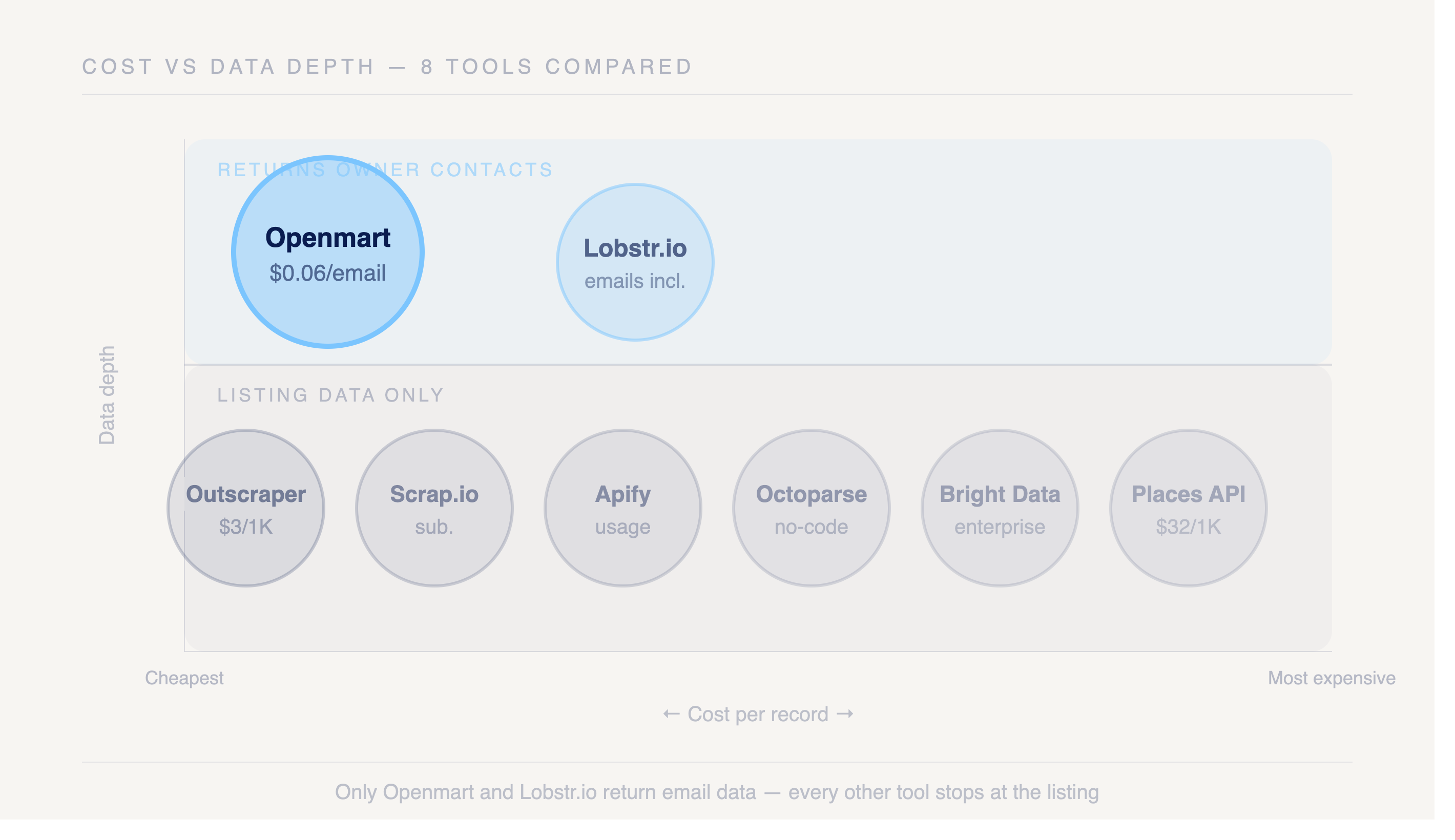
Scraping vs. pre-built database: which is right for you?
| Tool | Owner contacts | Setup time | Pricing from | Compliance | Throughput | No-code | Best for |
|---|---|---|---|---|---|---|---|
| Openmart | ✓ Verified | Minutes | Free | GDPR/CCPA ✓ | 600–6,000 req/min | ✓ | Owner outreach |
| Outscraper | ✗ | Minutes | $3/1K records | ToS risk | Not published | ✓ | Budget pulls |
| Apify | ✗ | Hours | $49/mo | ToS risk | Not published | ✗ | Custom pipelines |
| Scrap.io | ✗ | Minutes | $35/mo | ToS risk | Not published | ✓ | Geographic exports |
| Octoparse | ✗ | Hours | $69/mo | ToS risk | Not published | ✓ | Visual scraping |
| Lobstr.io | ✗ | Minutes | Per request | ToS risk | Not published | ✓ | Quick exports + email |
| Bright Data | ✗ | Days | $0.75/1K | ToS risk | Millions of requests | ✗ | Enterprise infra |
| Google Places API | ✗ | Hours | $17/1K requests | ✓ Compliant | No rate limit (billed per request) | ✗ | Compliant listing data |
How to choose
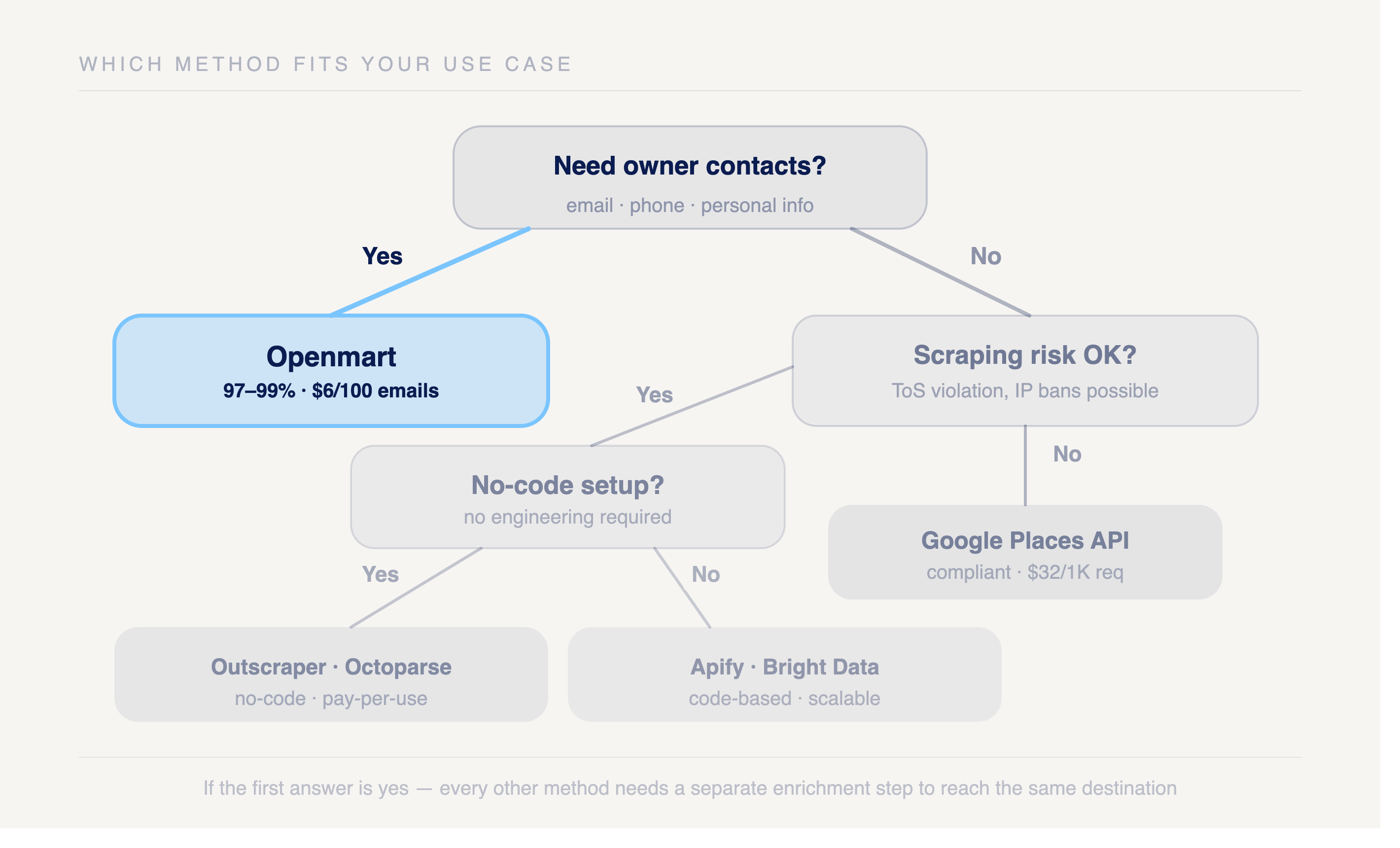
- Need raw listing data for a one-off project and comfortable with cleanup? Outscraper (pay-as-you-go, no commitment).
- Need a maintained scraping infrastructure for custom pipelines? Apify or Bright Data.
- Need compliant structured data inside Google's ecosystem? Google Places API.
- Need verified owner contacts ready for outreach without building a scraping stack? Openmart.
- Need a subscription-based scraper with geographic search filters and no per-record fees? Scrap.io (city/region/country tiers).
- Need a no-code visual scraper with cloud scheduling and captcha handling? Octoparse or Lobstr.io.
The key question is whether you need the listing or the owner. Scraping tools give you the listing. Openmart gives you both.
Frequently asked questions
Is it legal to scrape Google Maps? Scraping Google Maps violates Google's Terms of Service. Google actively blocks automated access with captchas and IP bans. The legal risk varies by jurisdiction, but the ToS violation is consistent. The Google Places API is the compliant alternative for structured listing data. 👉 developers.google.com/maps/terms
What is the Google Places API rate limit? The Places API returns a maximum of 60 results per search query (3 pages of 20). There is no hard rate limit on requests per minute, but each request is billed individually. Heavy usage requires careful cost management. 👉 developers.google.com/maps/documentation/places/web-service/usage-and-billing
How do i get owner contact information for local businesses? Google Maps does not include owner contact data, only the public listing phone and website. To get verified owner emails and direct phones, you need a purpose-built database like Openmart, which covers 50M+ local businesses with 97-99% owner contact accuracy. 👉 openmart.com/products/business-owner-finder
What is the best Google Maps scraper? The best tool depends on your use case. Apify (458k+ users, 4.8/5) is the most widely used for custom developer pipelines. Outscraper is the most accessible for pay-as-you-go pulls. Scrap.io suits teams needing subscription-based geographic exports. Octoparse and Lobstr.io are the top no-code options. None of these return verified owner contacts — for that, Openmart is the purpose-built alternative.
Which Google Maps scraper API can scale to millions of records? For extraction volumes in the millions, Bright Data and Apify offer the most mature large-scale scraping infrastructure, with Bright Data built specifically for high-volume proxy-based collection. Openmart supports the same scale for owner-contact enrichment, with API throughput of 600–6,000 requests/min and batch endpoints handling up to 100 records per call, so listings and verified owner data can be pulled together without a separate enrichment step.
How much does Google Maps data extraction cost? Costs vary by method. Google Places API: $32/1,000 Nearby Search requests. Outscraper: $3/1,000 records (pay-as-you-go). Apify: from $49/month. Bright Data: from $0.75/1,000 records. Openmart (pre-built, with owner contacts): $6/100 verified owner emails, free to search.
What is the difference between Google Maps scraping and a local business database? Scraping extracts raw listing data from Google Maps on demand, business name, address, and public phone number, with no owner contact and no verification. A local business database like Openmart pre-verifies and enriches those records, delivering owner personal email, direct phone, tech stack, and revenue estimate alongside the listing data. 👉 openmart.com/blogs/lead-scraping-tools-vs-pre-built-databases
Related articles


Start reaching local businesses today
No credit card required
50M+ local business databases


.png)
