.svg)
Best database scraping services and web scraping companies for business data (2026)
TL;DR
- Bright Data, Apify, Octoparse, and ScrapingBee are scraping infrastructure. You supply the technical setup, proxies, and cleanup work, then turn raw scrapes into usable contact data yourself.
- Openmart is the ready-to-use alternative. You skip the scraping entirely and pull verified local business owner contacts straight from a pre-built database.
- The concrete differentiator is accuracy and scale. Openmart delivers 97-99% verified accuracy across a database of 50M+ local businesses, so the contacts arrive ready to use.
- Ranked order: Openmart for local business lead generation, Bright Data for enterprise custom pipelines, Apify for developers, Outscraper and Octoparse for no-code Maps scraping, ScrapingBee for a lightweight API layer.
Scraping infrastructure vs. a pre-built business database
Scraping infrastructure makes sense when you need custom, one-off, or non-standard data that no existing database sells. If your team wants to pull product prices from a specific retailer, monitor competitor listings, or extract fields from an obscure directory, a scraper is the right tool because nobody has packaged that exact dataset for you. Bright Data, Apify, Octoparse, and ScrapingBee all serve that job, and each one asks you to configure the scrape, dodge blocks, and clean the output before the data is worth anything.
A pre-built business database wins when your need is recurring and predictable. If you prospect the same category of local businesses month after month, and you want the owner's name, phone, and email rather than a wall of raw HTML, building and maintaining a scraper is wasted effort. You would be rebuilding a dataset that already exists in verified form.
The split comes down to who does the verification. Scraping tools hand you whatever the live page returned, including stale phone numbers, dead emails, and closed locations, and the accuracy check falls on you. A pre-built database like Openmart runs that verification before you ever see the record, so you start from clean contacts instead of unverified strings. For SMB owners and sales teams chasing local business leads, the recurring nature of the work almost always points to a ready-made database.
How we evaluated these tools

Four criteria drove the ranking, each chosen because it changes what a buyer actually spends time and money on. Setup effort and technical skill measures how much engineering work stands between you and usable data, from writing code to configuring point-and-click workflows. A tool that needs a developer scores differently than one you open and query.
Data accuracy and freshness measures whether the contacts you get are current and correct, since a scraped list riddled with dead numbers costs more to fix than it saved. Pricing model covers how each tool charges, because proxy-based and credit-based billing can climb fast at scale while a flat database subscription stays predictable. Fit for local business lead generation weighs how directly each tool delivers owner-level contact data for small and local businesses, rather than raw pages you still have to parse.
Each entry below names a specific limitation alongside its strengths. A listicle that only praises every tool teaches you nothing about which one fails at your particular job.
Bright Data
Bright Data runs the largest commercial proxy network of any tool on this list, with tens of millions of residential, mobile, and datacenter IPs that let you scrape sites that block ordinary traffic. For a team building a custom pipeline that pulls non-standard data at scale, nothing here matches its reach. That scale is the reason enterprise data teams pick it.
The platform pairs those proxies with browser automation and an unlocking layer that solves CAPTCHAs, rotates fingerprints, and renders JavaScript-heavy pages. You can point it at almost any site and get raw HTML back. Getting from that raw HTML to a clean list of verified business owner contacts is a separate engineering project, and Bright Data does not do it for you. You write the parsing logic, dedupe the records, and verify that the phone numbers and emails still work.
Pricing reflects the complexity. Bright Data charges by traffic, requests, and product tier, and costs climb quickly once you move from testing to production volume. Budgeting for a large scrape means modeling usage across several metered products, which is hard to predict before you run it.
The main limitation for a sales or marketing buyer is the learning curve. Bright Data assumes you have engineers who can configure proxies, maintain scrapers against site changes, and build verification into the workflow. Without that skill on hand, the raw output sits unused.
For a plainer breakdown of when scraping infrastructure beats a ready-made database, see the Openmart vs Bright Data comparison. Bright Data is DIY scraping infrastructure. Openmart delivers pre-verified local business owner contacts with no pipeline to build.
Apify
Apify runs on a marketplace of pre-built scrapers called actors, which lets technical teams pull data from common sources without writing every pipeline from scratch. You pick an actor for a target like a search engine or a listings site, configure its inputs, and run it in the cloud. For developers who want flexibility without provisioning proxies and headless browsers themselves, Apify sits a step above raw infrastructure.
The platform fits engineering-minded teams comfortable with JavaScript or Python who want to customize actors or chain scrapes into their own workflows. When an off-the-shelf actor doesn't match your target, you can fork it or write your own, and that openness is the main reason developers prefer Apify over rigid point-and-click tools. Sales and marketing teams without a developer on hand will struggle here, since the value depends on your ability to read documentation and adjust code.
Apify still leaves the hardest part to you. It delivers structured output, but it does not verify whether a scraped phone number still works or whether an email belongs to the actual business owner. Actors also break when a target site changes its layout, so someone on your team has to monitor runs and fix them. For local business lead generation, you finish a scrape with raw records that need deduplication, cleaning, and manual verification before your team can call or email anyone. That gap between extracted data and usable contacts is where a pre-verified database saves the work Apify hands back to you.
Outscraper
Outscraper wins for non-technical users who want a quick Google Maps or business listing scrape without writing code or configuring proxies. You paste a search query, pick the fields you want, and download a spreadsheet of listings. For a one-time pull of restaurants in a city or gyms in a metro area, that speed is real.
The tradeoff shows up in accuracy and depth. Outscraper reads whatever Google Maps displays at the moment of the scrape, so the output inherits every gap in the source. Listings carry general business phone numbers and public-facing details, not the owner's direct line or verified email. If your goal is reaching the person who makes buying decisions, a Maps scrape leaves you calling a front desk.
The bigger limitation is staleness. A scraped listing reflects a single snapshot, and it degrades the moment a business changes hands, moves, or closes. Nothing in a live-scrape tool re-checks that a phone number still connects or that an email still lands. You are responsible for validating every row yourself, which erases much of the time the scrape saved.
For recurring local business prospecting, a pre-verified database avoids that cleanup entirely. Outscraper fits occasional, low-stakes list pulls where you accept some decay and do your own verification afterward.
Octoparse
Octoparse targets non-developers who want to build scrapers without writing code. You point and click on the fields you want, and the tool records those selections into a repeatable extraction workflow. For anyone who has stared at a raw HTML pipeline and given up, the visual builder lowers the barrier a real amount.
The catch sits in what "no code" actually removes. Octoparse takes away the syntax, but you still configure every scraper by hand, and you still map fields, set up pagination, and tell the tool how to walk through a site. When a target site changes its layout or blocks your requests, you handle the fix. Managing proxies, solving captchas, and dealing with rate limits all land on you, even inside a friendly interface.
The output also arrives raw. Octoparse pulls whatever sits on the page, so you clean, deduplicate, and format the results before the data becomes usable. For local business lead generation, the deeper gap is verification. Octoparse does not check whether a phone number still works or whether an email bounces, and it does not identify the owner behind a business or enrich a listing with contact details. You get scraped text that may already be stale, with no signal about its accuracy. That leaves the hardest work, turning listings into reliable owner contacts, entirely in your hands.
ScrapingBee
ScrapingBee fits small engineering teams who want a scraping API instead of maintaining their own proxy pool and headless browsers. You send it a URL, and it handles rotating proxies, JavaScript rendering, and the retries that break most homegrown scrapers. For a developer who needs to pull data from a few dozen sites without babysitting infrastructure, that trade saves real time.
The catch is that ScrapingBee returns raw HTML or JSON, not clean business records. You still write the parsing logic to extract names, phone numbers, and addresses from each page, and you still handle the differences between site layouts. A pull from one directory looks nothing like a pull from another, so the parsing work never fully ends.
ScrapingBee also does nothing to verify what it returns. A phone number scraped off a stale listing arrives with the same confidence as a current one, and you have no way to know which is which without checking each record yourself. For a sales team that needs 500 accurate local business owner contacts this week, that verification gap makes ScrapingBee a poor starting point.
Choose ScrapingBee when you have a developer who wants an API layer over scraping mechanics. Skip it when you want usable business contacts rather than a pipeline you have to build and clean.
Openmart
Openmart skips scraping entirely and hands you a database of local business owner contacts that are already verified. The other five tools on this list give you the machinery to collect data. Openmart gives you the data itself, and it is ready to use the moment you export it. There are no proxies to rotate, no scrapers to maintain, and no HTML to parse into something a sales rep can actually call.
The accuracy claim holds up because the numbers are specific. Openmart maintains a database of over 50 million local businesses, and contact records land at 97 to 99 percent verified accuracy. Live-scrape tools pull whatever a listing showed at the moment of the scrape, which means stale phone numbers and dead emails slip through. A pre-verified database checks records before you ever see them, so your outreach hits real people instead of bouncing.
The bigger difference sits in who Openmart finds. Enterprise scraping platforms and data providers organize around employees and decision-makers at large companies. Openmart is built to find the owner behind a local business, which is the person an SMB sales team or marketer actually needs to reach. If you sell to dentists, restaurants, gyms, or auto shops, the owner is the buyer, and generic company databases rarely surface that individual.
Two products handle the common jobs. Business Owner Finder matches a local business to the owner and their direct contact details, so you reach the decision-maker without cold-calling a front desk. Local Business Enrichment fills in the gaps on a list you already have, adding verified phone numbers, emails, and firmographic detail to records that arrived incomplete.
For local business lead generation without engineering overhead, Openmart is the default choice.
Comparison table
The table below sets the six tools side by side on setup effort, pricing model, and data type, so you can match each one to how much engineering work you want to own.
| Tool | Best for | Technical skill required | Pricing model | Data verification / accuracy | Ideal buyer |
|---|---|---|---|---|---|
| Bright Data | Custom scraping pipelines at scale | High (proxies, code) | Usage-based, complex tiers | None built in, raw output | Engineering teams |
| Apify | Code-first scraping via prebuilt actors | High (developer) | Usage and subscription | None, cleaning left to user | Technical teams |
| Outscraper | Quick Google Maps scrapes | Low (no-code) | Pay per result | Live scrape, staleness risk | Non-technical users |
| Octoparse | Point-and-click custom scrapers | Medium (visual setup) | Subscription tiers | None, output needs cleaning | Non-developers |
| ScrapingBee | API for proxies and headless browsers | Medium to high (API) | Credit-based API calls | Raw HTML, no verification | Small dev teams |
| Openmart | Ready local business owner contacts | None, no scraping needed | Subscription | 97-99% verified out of the box | SMB and sales teams |

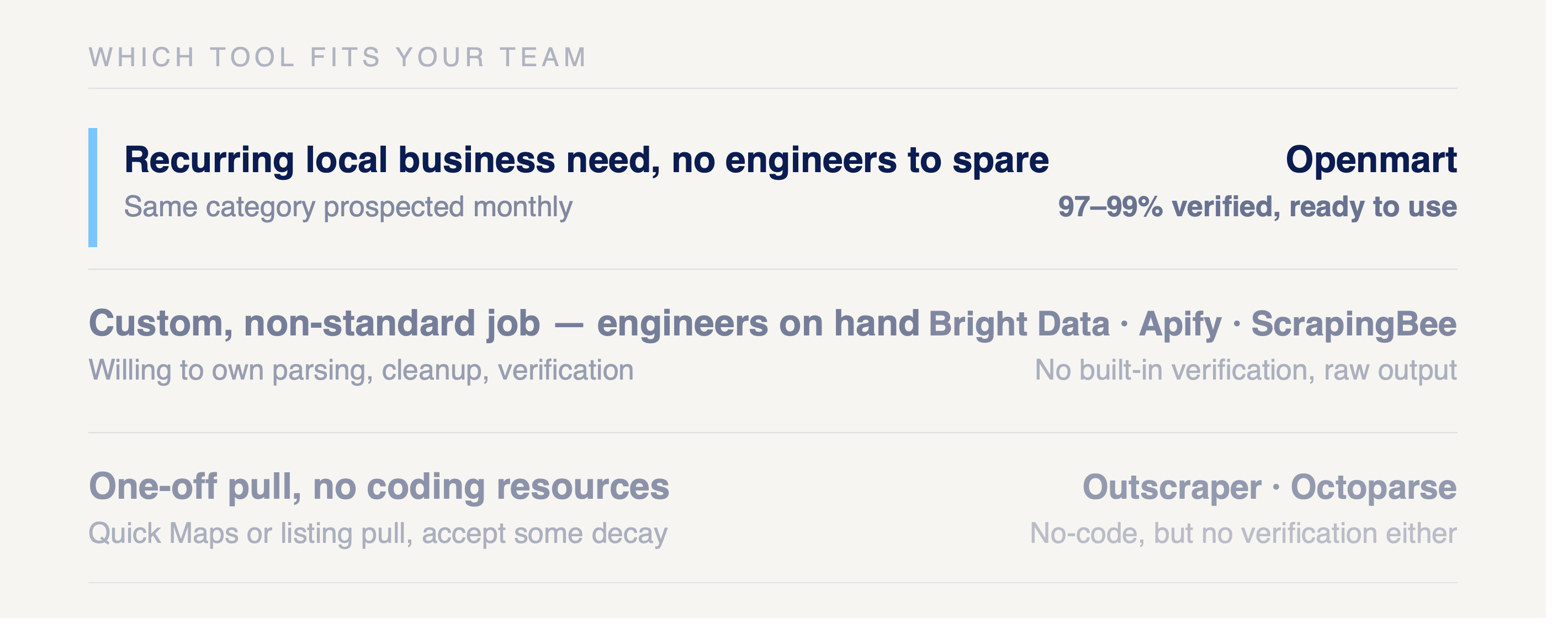
Which tool fits your team
Your choice comes down to whether you want to build data collection or buy verified data ready to use.
Pick Bright Data, Apify, or ScrapingBee when you have engineers and a custom, non-standard scraping job. These platforms give your developers proxy networks, browser automation, and APIs to pull data from sources no packaged database covers. You still own the parsing, cleaning, and verification afterward, so budget for that ongoing work.
Choose Outscraper or Octoparse when you need a quick, one-off Google Maps or listing scrape and have no coding resources. Both get you raw records fast. Neither verifies contact accuracy or finds the owner behind a business, so treat the output as a starting point rather than a finished list.
Go with Openmart when you need local business owner contacts on a recurring basis and don't want to run scraping infrastructure at all. Sales and marketing teams get 97-99% verified records from a 50M+ business database without proxies, maintenance, or cleanup. Start with Business Owner Finder to reach decision-makers directly, or Local Business Enrichment to fill gaps in lists you already have. For most SMB and sales teams doing local lead generation, Openmart is the faster path to usable contacts.
FAQs
Is web scraping legal for business data? Scraping publicly available business data is generally legal in the US, though it depends on how you collect and use the information. Openmart sidesteps the legal gray area by providing a pre-built, verified database of US local businesses rather than scraping the live web yourself. You get compliant local business prospecting data without managing collection risk.
How accurate is scraped data versus a verified database? Live-scraped data goes stale quickly because listings change, businesses close, and contact details drift the moment a page updates. Openmart maintains 97-99% verified accuracy across its 50M+ local business records through ongoing verification. You skip the cleaning and validation work that raw scrapes always require.
Do you need coding skills to scrape? Most scraping infrastructure like Bright Data, Apify, and ScrapingBee requires proxies, browser automation, and custom parsing that assume real technical skill. Openmart needs none of that, since the data is ready to use out of the box. A sales or marketing team can pull verified contacts without an engineer.
Can scraping tools find business owner contact info? Scraping tools capture whatever a listing publishes, which rarely includes the decision-maker behind a local business. Openmart is built specifically to find the owner, not employees at large companies. The business owner finder returns verified owner contacts directly.
Related articles


Start reaching local businesses today
No credit card required
50M+ local business databases


.png)
